All posts by EssiMaria

Four seasons in two cities, spaced out in some homes or not / May 2018

Until recently I led what looked to be quite a global life.  Not in an elite, business class, kind of way, but because of my work I did travel regularly, and many of my closest friends lived in different countries.  There was even a good friendship I had made off the back of one encounter in real life and then a meeting of the minds over time on Facebook.  Some friends I reconnected with after gaps of 10 or 15 years through other friends in a web spreading over several countries.  I had close colleagues whose voices and opinions I had become very fond of over Skype without ever having met them in person.  

Motherhood changed all of that.  In those early months, there is nothing a baby needs more than to be physically close to its parents, and nothing the parents need more than to feel that the baby is ok.  And I don’t say this in a cultic ‘parenting tribe’ way.  The only parenting approach I have ever followed is the #thatjusthappened #whateverworks  school. Exhausted but surviving  A baby-sling was liberating, especially in London, where you can never rely on lifts to be working at train stations.  A pushchair was more liberating in Helsinki, where you ride for free on public transport if your baby is in a pushchair but not in a sling. 

In Helsinki, in the incredibly rainy October/November we had, still not well networked socially, our world got even smaller.  The rental flat we got because of its closeness to our daughter’s nursery became a kind of job for me.  It was brand new, in a concreted, businessy, re-developing area of Helsinki. The flat was as far removed from the memories of log cabins by lakes from my childhood as it was from our draughty Victorian terraced house in  London, which had bellyached constantly from the conflict of a 21st century family living in a 19th century house.  We had spent several weeks of our last month in London without a functioning bathroom but it was hot enough outside to just hose the kids down on the patio, while every winter our state-of-the art wifi-connected boiler ran out of battery in its thermostat and plunged us back into authentically Victorian cold.  During my dissertation work I had pondered Corbusier’s idea of the ‘house as a machine for living’ and now in Helsinki I got to experience being in such a machine, impersonal but more comforting than the perpetual grey rain outside.

I had to keep the flat happy, and at the same time accept I could not control it.  The heating came on not because I turned it on but when a pre-programmed thermostat decided it should.  The house was so well built and insulated that until the mercury hit zero outside the heating barely came on at all, and I was so warmed by the solar energy from our south-facing windows that in this apartment I could pad around barefoot in vest and leggings in the middle of winter.  But the flat extracted a price in terms of closely-regulated behaviour.  The air exchange system required bathroom doors to be shut so that they could be dehumidified properly.  I became the guardian of the apartment’s needs, not its resident, but its maintenor.  I compensated for other people not understanding its needs by remaining perpetually vigilant, pressing appropriate buttons on the environmental control and never complaining that the building, not I, decided what my indoor temperature should be.  

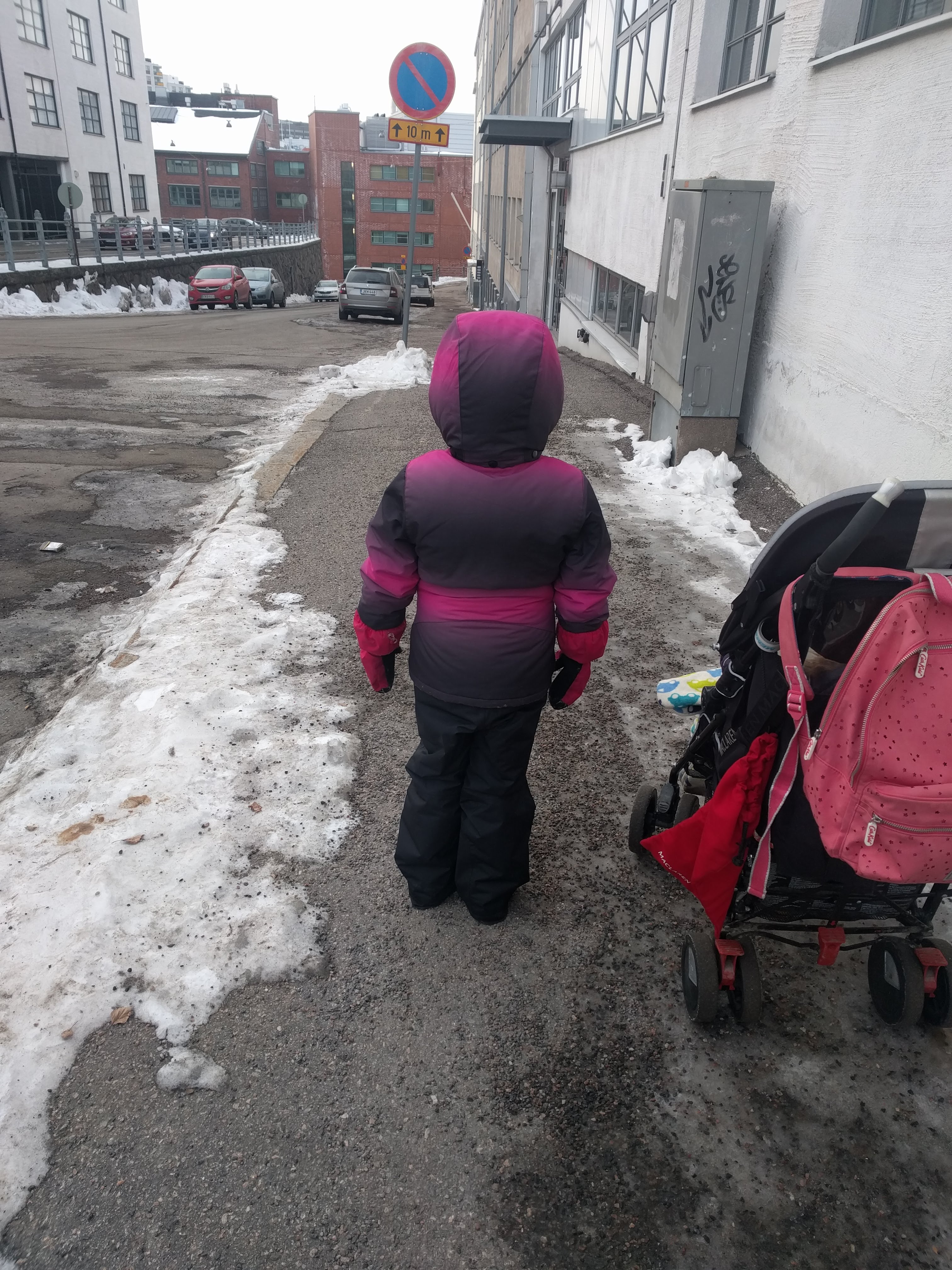
The outside streets were frightening to me.  Twice daily we had to face them to take my daughter to nursery and bring her back.  I could not understand why cars were allowed to ride, even in a stately and slow fashion along our pavement, when there was a whole huge road and a parking lane for their use.  I couldn’t understand how this society, that I had heard was so safe for children, could allow a culture where it was okay for cars to nudge their bonnets onto a zebra crossings as I took my children over calling out ‘green man, safe for us to cross’ more as a tight-throated prayer than a cheerful public service announcement.  When the snow started, the ploughs piled it up along the side of the road so the cars could scoot through, but I would have to lift the pushchair over a ploughed and packed snowdrift eighteen inches high to get onto the crossing, leaving the four year old to get over it as best she could by herself.

I had also given up on getting to know new Finns.  I was tired of psyching up my daughter to approach kids in playgrounds only for her to be rejected, and I was fed up of trying to initiate conversation with mothers who didn’t want to talk to me.  This society was doing well, it was a good society and it didn’t need us, was the firm message coming from Helsinki.  I felt we were seen as disruptive, badly dressed, illiterate.  My machine-flat was clean and warm, and in the absence of human or natural noise, the hum of the trams going past became something I listened out for with affection.  My space became my flat and the tram ride to two baby groups that catered for immigrant mums, and the twice-daily, terrifying, car-harassed nursery run.  I would go to a cheap cafe on the way back from nursery for a re-heated bun and send a picture to Annika with the message “one for Shitstagram,” and shared laughter helped. Then the snow happened. 

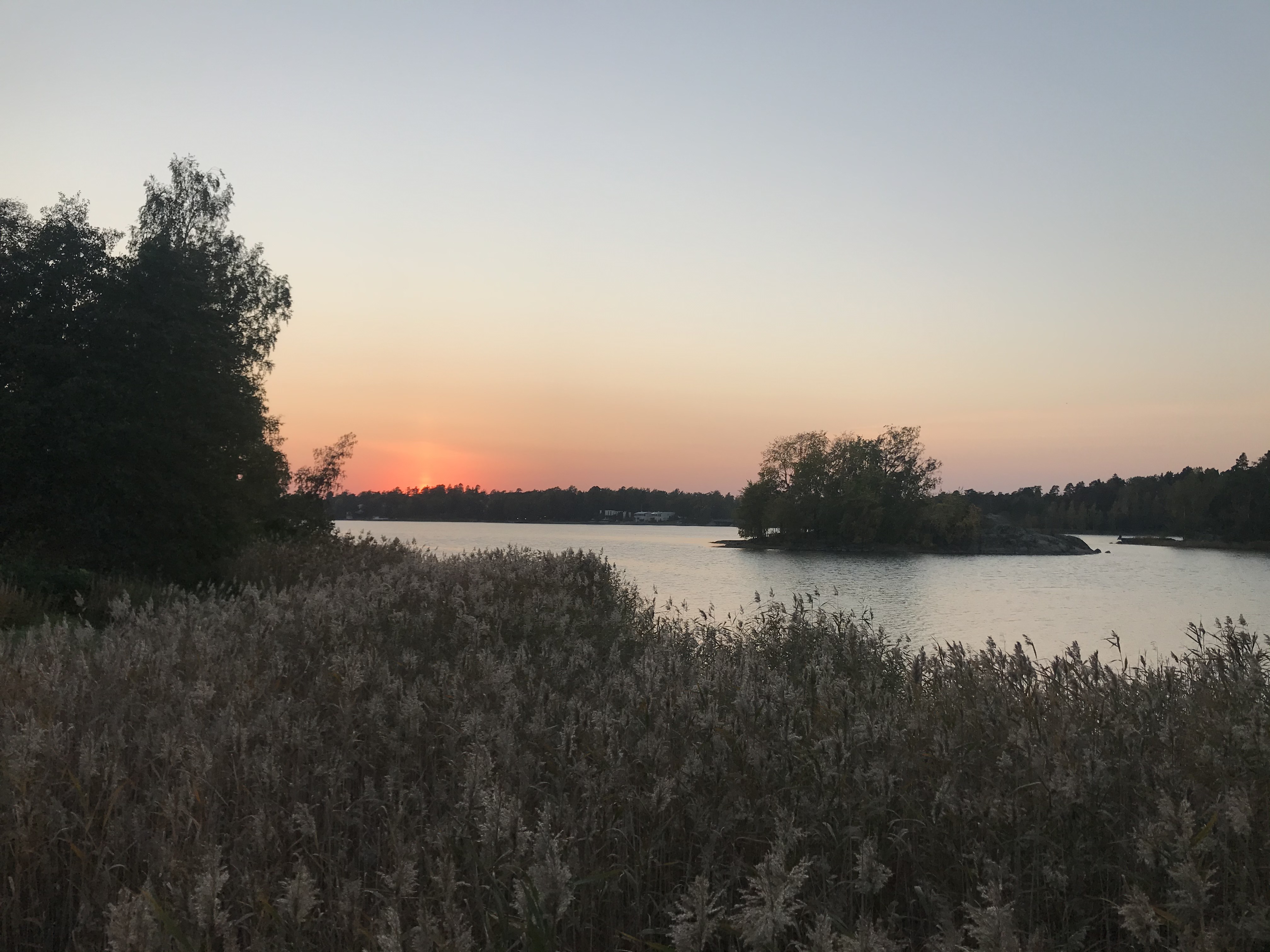
Thank God for the snow.  If I had asked Google to map my movements I would have seen an exponential increase in daily space covered between the end of November and the end of January. Going outside the city at weekends to go tobogganing, or on walks across the frozen sea. In the week, going to a stop on the metro with my baby son and just walking until I found a patch of coastline and looking at the pale gold reeds against the white ice and lapis lazuli sky, or the iron grey islands gripped in skirts of snow, the fir trees like dark hairpins.  I grieved all over Helsinki and Espoo for my grandparents, who had never been able to see that I would come back to Finland, and that I was trying, however inadequately, to give my kids a door to the Finnish side of their identity.  In the new flat we bought by the sea I communed with the amber-coloured wood flooring because it reminded me of them, and then walked over the necklace of little bridges and green islands and blue sea.  

I still feel I am on a piece of elastic and if Toby let go, I would ping back to London so fast that I’d brain myself on the front door at Dennett’s Road.  But summer here is beautiful.  The air smells of pine and roses, and walking through forests carpeted with lily of the valley to a beach that is both secluded and 20 minutes away on the bus feels like a dream.  I am hopeful for picking bilberries and lingonberries in the late summer.  I realised something important about my career, which is that I want to be able to spend more time outdoors.  I don’t know what that looks like.  I feel closer to Asian influences in Finland than I did in the UK, which is interesting, as I assumed the UK was the more global country.  I am not at home.  I can’t be.  But I can try to live resolutely in a place without having to have it feel like home.     
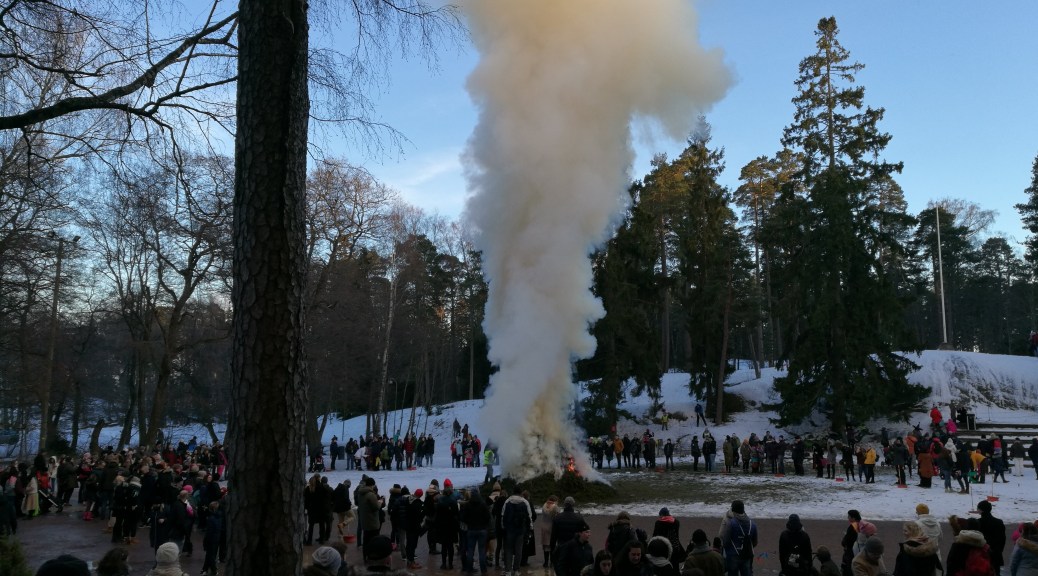
The kinds of men we voted for last weekend

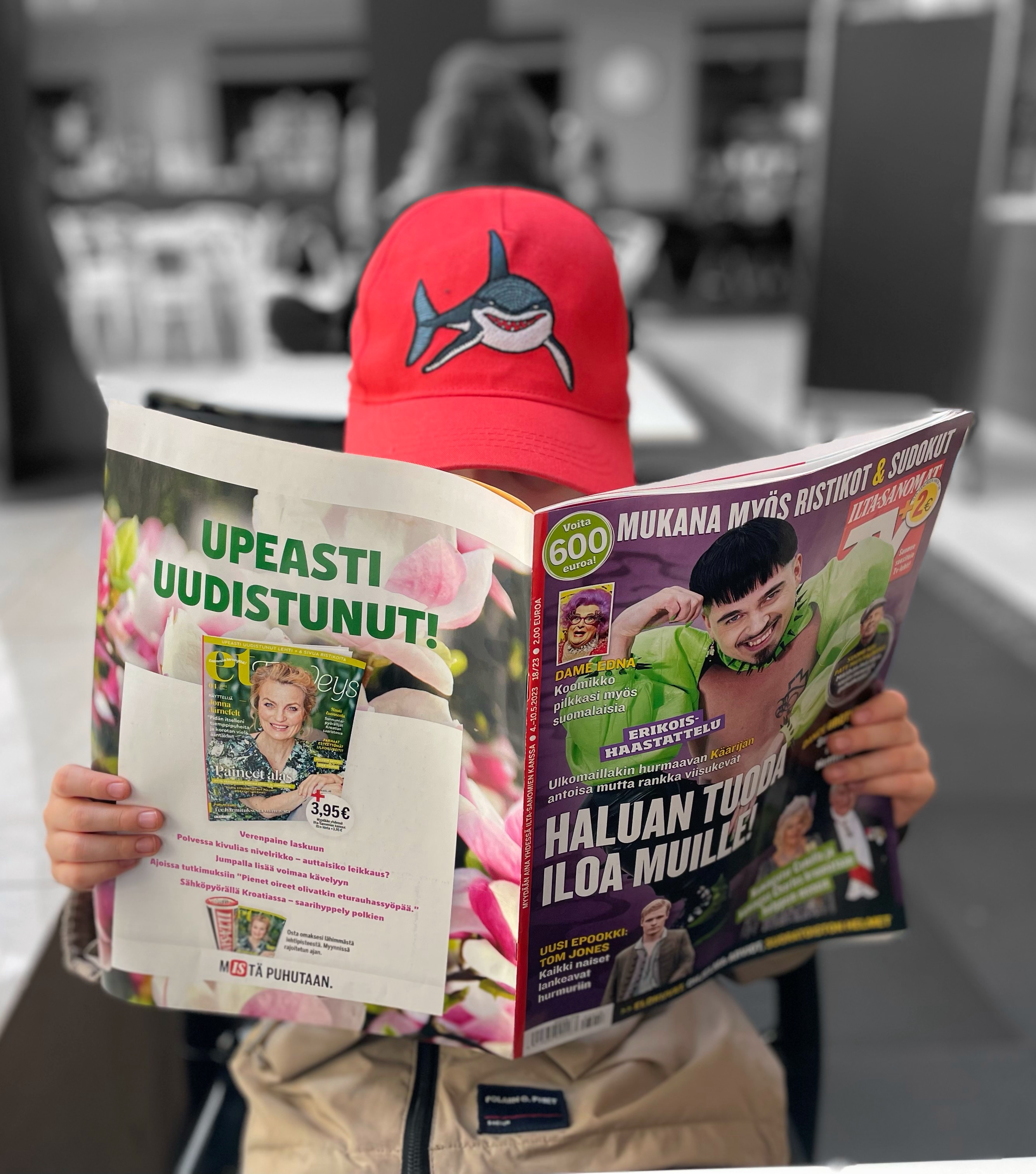
There was an election in Finland last weekend, for the President; and a selection, for our 2024 Eurovision entrant. After the weekend I had some thoughts about masculinities, and ChaChaCha… When Käärijä, Finland’s Eurovision star in 2023, won the right to represent Finland on the glitteriest of European stages, I felt that it told me something important about Finnish men. Perhaps we had moved on from our sadness.

Anyone my age and over in Finland knew one of those men who succumbed to “the Finnish disease”: alcoholism, and knew the trails of loss and violence that they left behind. We also knew the others, the men who had defended and rebuilt the country, built families and oh, just built, and built, often silently, and they never talked about war-things. 

Käärijä was a sign to me that our men don’t any more have to be one of those two types from my childhood: sad-angry-drunk or building-responsible-sober. They can be shy, flamboyant, geeky with a crazy party side that loves pina colada. Käärijä has his nails done at the same salon chain as me. He turned up to sing to children at the President’s Independence Day celebrations. He is beloved but entirely on his own terms. He is absolutely a win for positive masculinity. He won the popular vote at Eurovision but not the jury vote – the juries went for something they recognised. But we just love him harder for that, in Finland, because we know about disappointment.

This year’s Finnish entrant was chosen at the Saturday Finnish selection vote in the same weekend as the Presidential election. Windows95Man, Finland’s elected representative to Eurovision is much less artistic to my taste (the denim thong is actually gross), but it is an act poised in a very Finnish mood between pain and comedy. Few people know how bad the economic depression was in Finland in the early 1990s, about the personal bankruptcies and the suicides. Windows95Man is a homage to the tech nerds who put Finland back on a path to recovery from that crisis. It’s a very niche celebration of a certain kind of (mostly) man that I think will be lost on the rest of Europe.

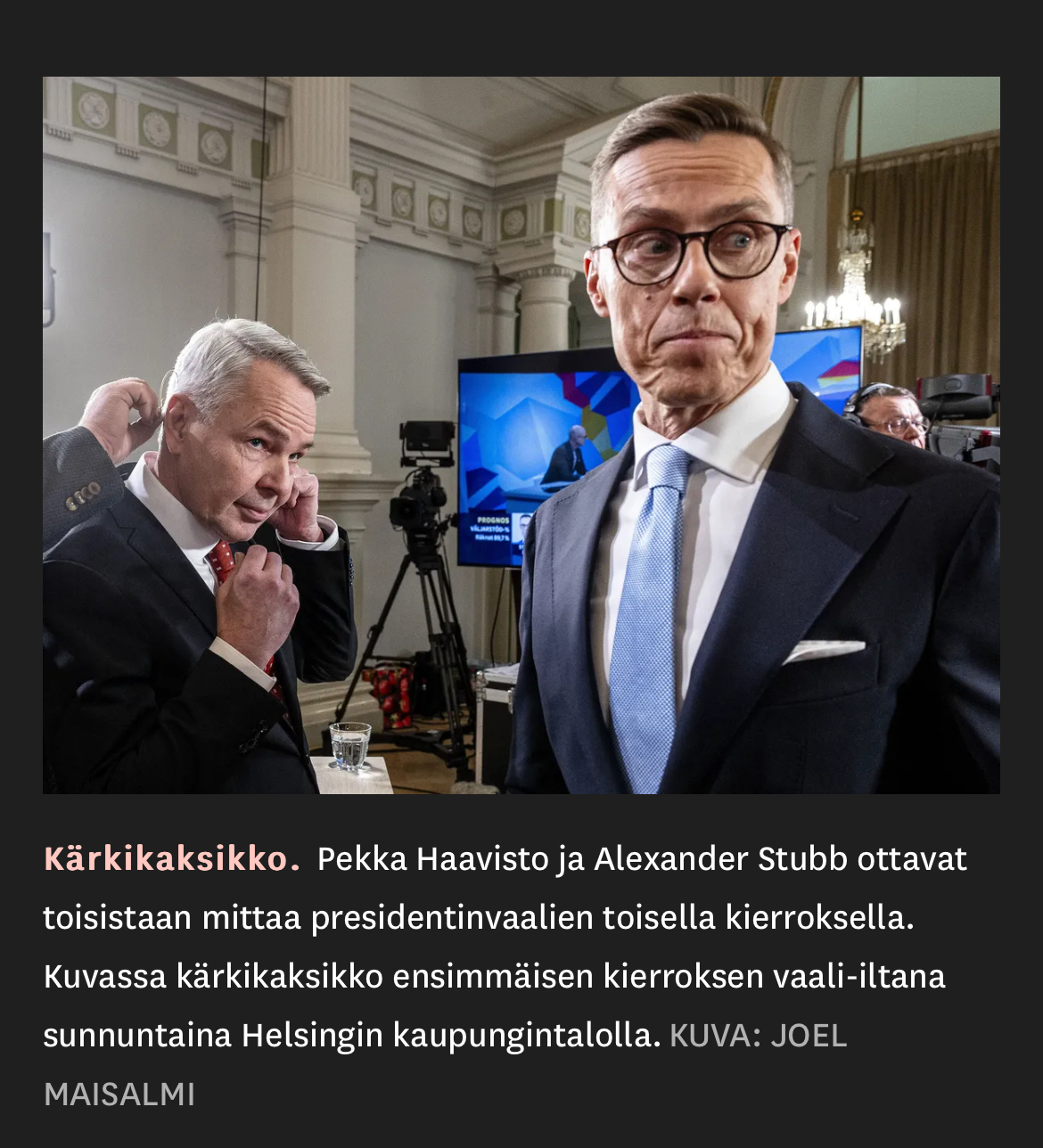
The other election in Finland last weekend was for the President, and a run-off between two white liberal men. I detected something in the way certain men talked about Alex Stubb having a “British Lawyer Wife” – why? Because she sounds like a trophy wife for cosmopolitan businessmen? Or to draw a subtle comparison to Haavisto and his Ecuadorean hairdresser husband? What are we supposed to be noticing here? 

The tall, groomed and confident Stubb won, but perhaps to his own silent regret as a dedicated cosmopolitan, won most outstandingly in the small towns and rural areas, sweeping the board in the religious revivalist areas, while Haavisto took the big cities. But if there was regret, it was silent indeed, Stubb seemed comfortable harvesting the homophobic vote. 

So in 2024 we are sending a crisis hangover to Europe’s biggest and campest music party; while in formal politics we see again that certain ways of being a man are still not tolerable for a large number of Finns. Hopefully we have a President who will keep the country at peace, which we can only do by being united and well defended. But hopefully he can also overcome having been silent on what I suspect to be his true values, otherwise what does that say about how and why he fights…? Is he only ambitious or is he a responsible state-builder?

But after the voting is all done and disappointment becomes memory, we still have ChaChaCha and I am grateful for that.

Talking to robots in Otaniemi at sunset

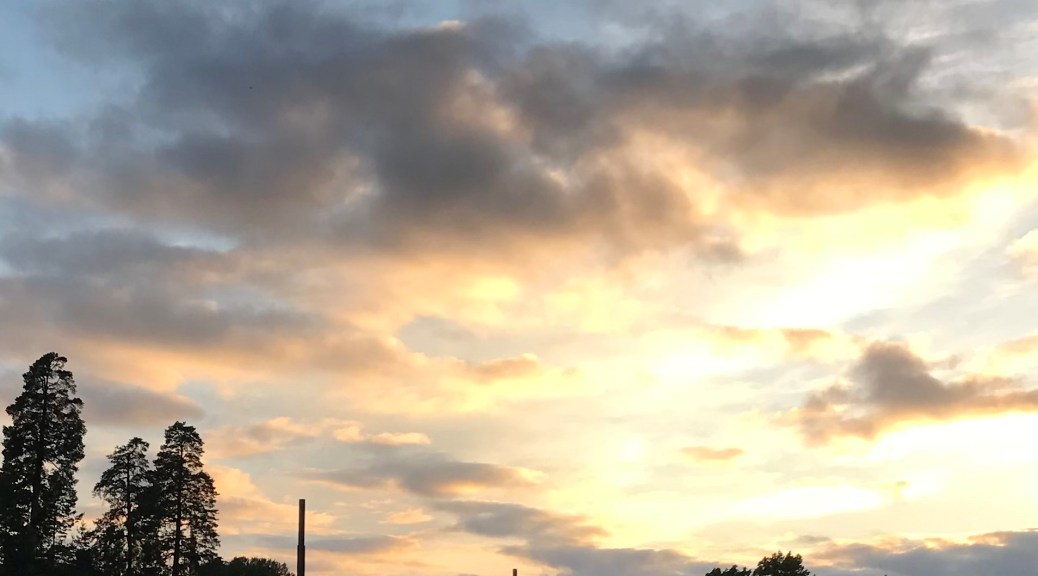
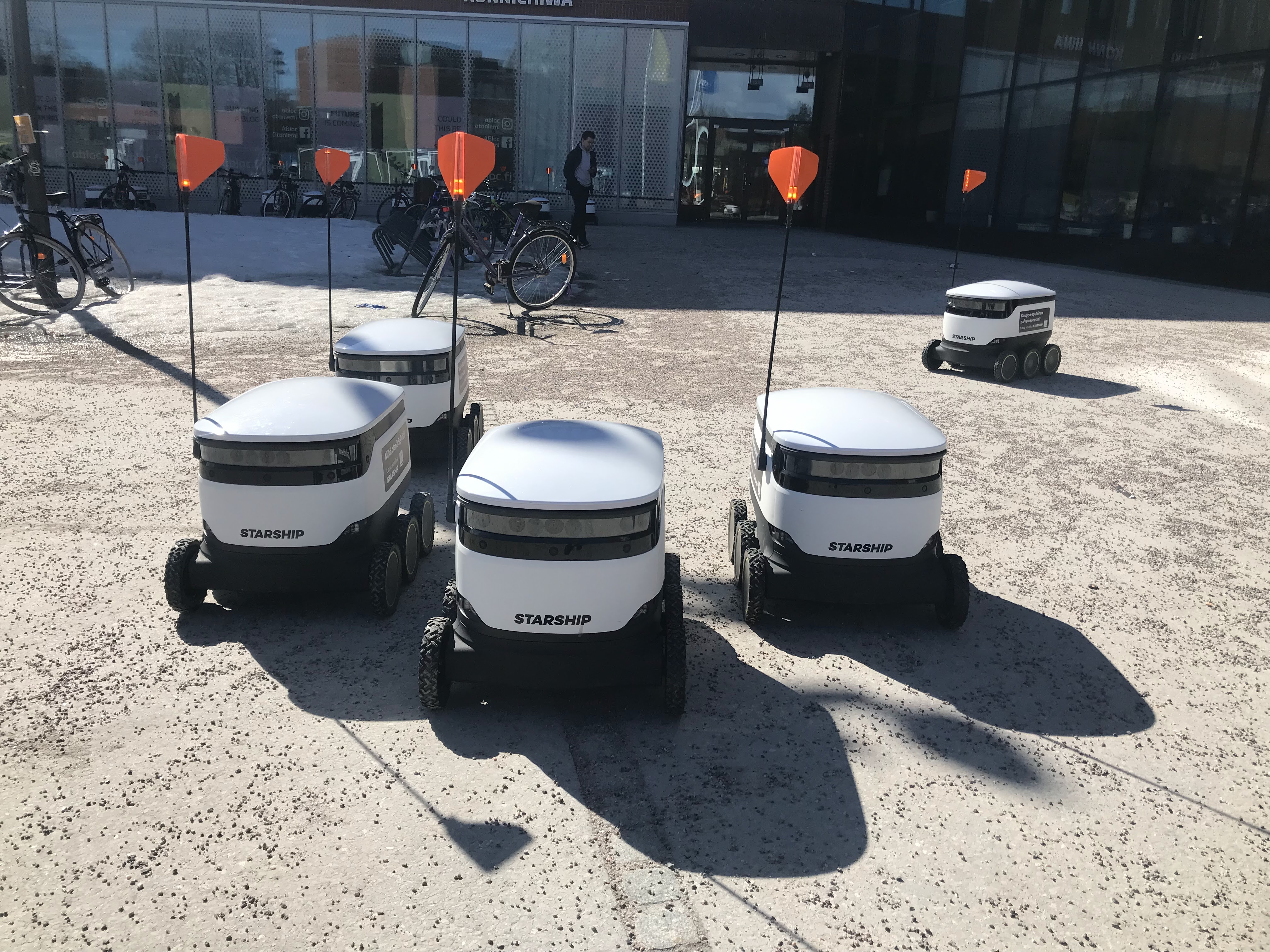
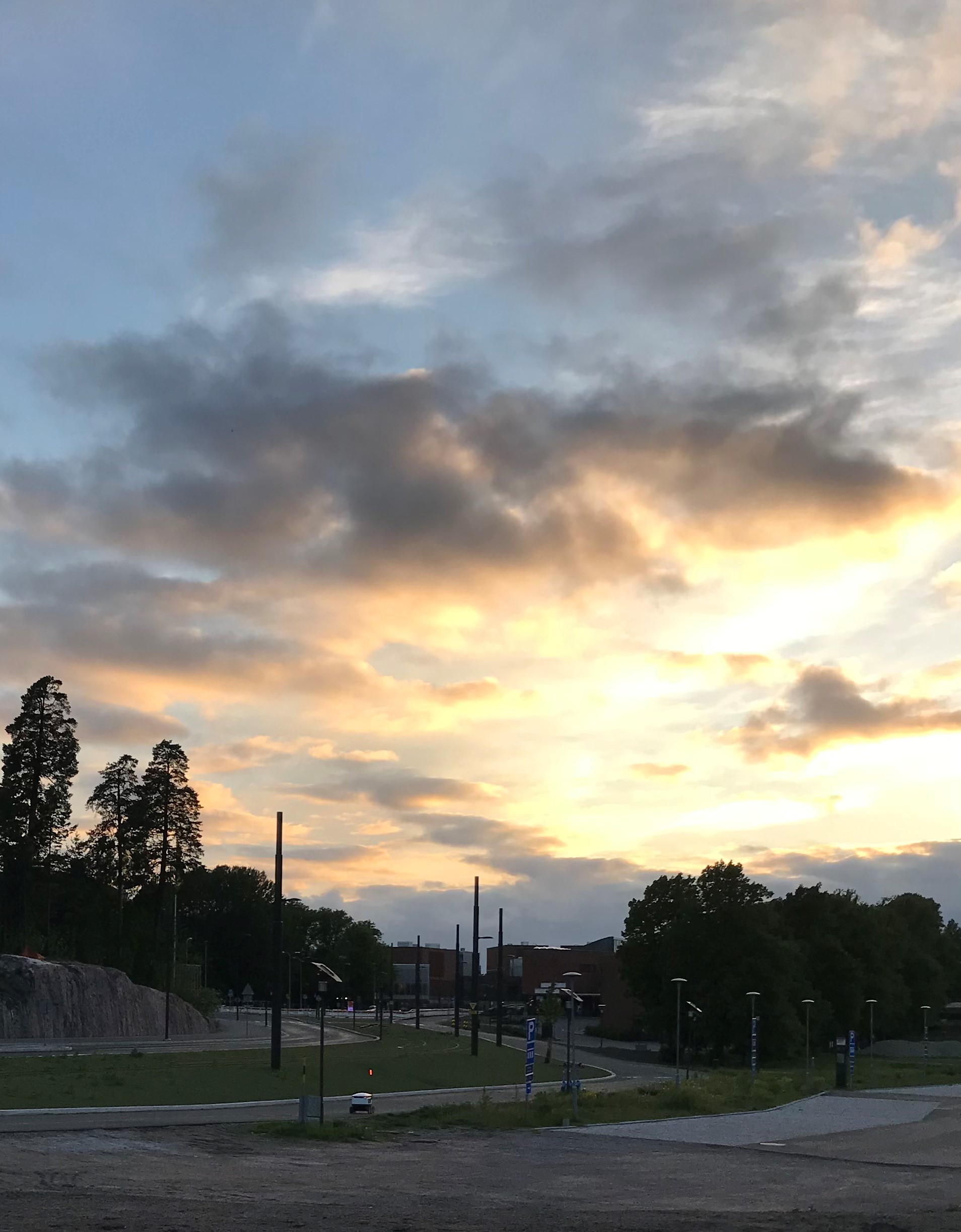
This evening on my way home against a lovely near midsummer Finnish sunset, a robot politely asked me to help it cross the road.  Our campus area at Otaniemi is host to a pilot of food delivery robots by Starship, they are modest, oblongs on wheels, probably deliberately not made too humanoid or science fictiony, more like a shopping trolley on wheels.  They even have a little orange flag on a pole sticking up at the back, like the child carrier fixed to my bike, to be seen by traffic.

They have become a normal part of life in Otaniemi already.  At first they were a novelty: students would stop to inspect them, children would shout “ROBOT” and gather round. When I took my son around the mall at the campus centre, he would try to interact with them, and so “don’t bother the robots, they’re working”  became part of our family chatter.  I accosted the product manager at a demo at the local supermarket and demanded to know if the robots would back down if they met someone in a wheelchair or with a pram in a narrow street (“ye-es” he said warily, and for now at least they are not a presence to resent if you have limited mobility, unlike abandoned e-scooters).   

At first they got stuck at the traffic lights: white boxes on wheels with a twinkly orange flag and an AI paid for by millions of Silicon Valley dollars, but no arms to press traffic light buttons.  In Otaniemi after 10pm, both human and road traffic quietens down a lot, so some robots got stuck for half an hour.  They made it into the news.  Silly robots. 

It is quite sweet to watch our local humans interact with the robots.  I have seen a young man cycling to a lecture stopping to press the traffic light button to help out a stuck robot, I have seen a pair of young women stopping to help one stuck in the grit that was left covering the streets after the winter ice had melted away.  I saw a robot this evening – possibly the same one that asked me for help later – riding tilting along the curb, wheels of one side on the pavement, other wheels along the road.  I watched it, it’s little orange traffic flag twinkling in the evening sun, half on the road, and I wanted to help but I stopped myself.  “It will never learn unless you let it work it out itself,” my mother voice sighed.  “And it is more on the pavement than the road, it’s quite safe.”

I was cynical when I first heard about these robots.  My husband showed me a picture of a robot and my London self said that’s going to get facking nicked, mate.But so far they seem not nicked, not vandalised, just a new robot on the block.  Overall, humans want to help the robots. 

The robot this evening asked me politely in Finnish to press the traffic light button for it, and I did, narrating what I was doing because I wasn’t sure what it could see.  Then I realised this was one of the new traffic lights put up in the roadworks, it probably exists in the map that the robot’s programmer was given, but it doesn’t actually work yet.  So I said “look, you’re just going to have to go across the road, there are no lights.”  And I didn’t know if there was a human listening who had taken control, or if it sensed and processed my language, or it just took an algorithmically determined chance, but off it trolleyed across the road.  I was left with so many questions. Did you hear me?  Did a human hear me?  Did you use a Finnish woman’s voice because a lens looked at me and a computer saw a Finnish woman, what would you have sounded like to my husband?  Would you have asked my children for help?  But the robot had its job to do, and its interaction with me was over.  I watched it roll away into the sunset, until it veered slightly off the path and got stuck in some grit.   I can’t help it,  I said to myself.  It’ll never learn about grit until it works it out itself. 


Keeping the lights on

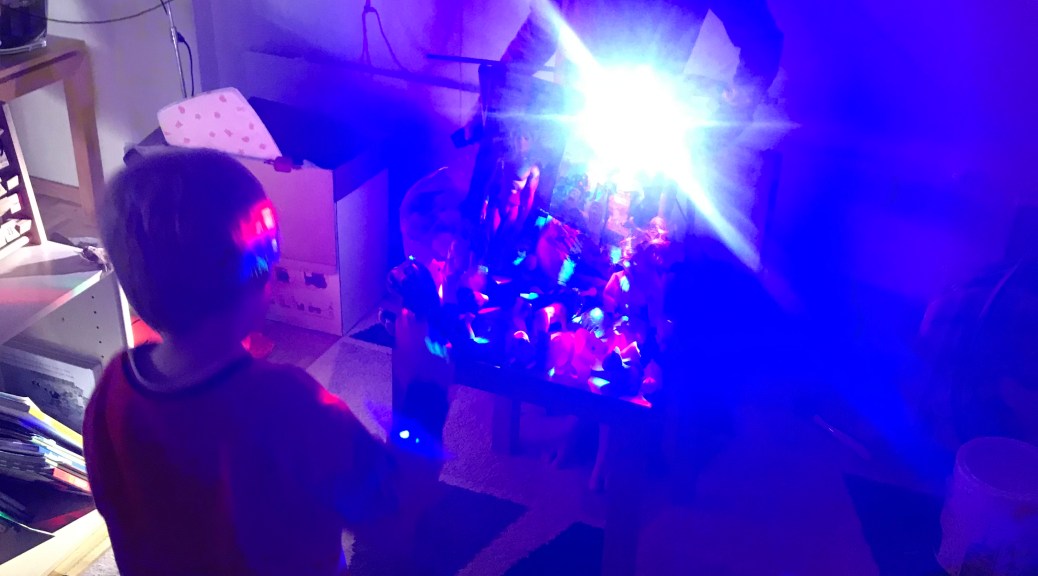
This morning, before I was completely awake, my son came into my bedroom with a handheld torch, instead of putting on the lights, in a bid not to wake me up. His father came in behind him and Harris shone the torch unevenly over the wardrobe for a monent, quickly round the bedside shelves, places where Toby was reaching for clothes or his watch. Harris was technically supposed to be helping Daddy, I think, but he is only 4 so the strange new potential of a light he can move himself is much more interesting than any mere purpose for it.  I lay in bed, my eyes drawn to the torchbeam like a cat’s, as it bounced around the walls and the curtains and the surfaces.  Our messy bedroom, which is also the junk room, still full of unpacked boxes – looked under torchlight like the backstage at a theatre, full of costumes and props.  The magic of light.

Two years ago, when the children’s daycare was nestled between the woods and the sea, I used to bring a torch for Sanna to carry on the return home on dark evenings, and a small electric lantern for Harris to watch in the footwell of his pushchair, and we were festooned with reflective badges and stickers.  Sanna’s torch was very interesting to the 5 year old boys.  “Can we look at your torch, Sanna” they would ask, and she would saunter all cool and “yeah okay” back to the daycare fence, the torch lying in the palm of her hand as if it was the most casual thing in the world to have a torch of your own, but the broad grin bouncing around her cheeks giving away her excitement, and the children would all crowd round to look at the torch for a few minutes and then she would stride home head up, torch out, ready for anything and holding her own. 

One year before that in Helsinki, I had arrived at a different daycare in the city, with the heavy and homesick heart of a recent migrant on a sombre evening and wondering how we would bear our first long, gloomy Finnish autumn-winter —  and been enchanted to see the twinkling pattern made in the dark by a dozen or so high vis vests as the little ones ran skittering around under the daycare’s playground lights.   And suddenly not so scared of the dark autumn-winter (and I did not even know then what it would feel like when autumn could contain the hope for flashy brilliant diamantine snow to come soon, and I did not know about the wonderful last weekend at Linnanmäki, our funfair in town, which turns itself on into one giant kaleidoscopic glitterbomb of coloured lights before closing for the season.  The weather may be too warm for snow this year, the fear of the virus may be too much to try Linnanmäki this year. Let’s not think about that yet.  The kids are good at sorting themselves out, they live in the present – when they want to, they just switch on the disco ball and blast music from a phone and they dance in swirling coloured lights.) 

This autumn I need light more than ever, but I have learnt to take my dark with my light.  I read about the Chinese tradition of the midautumn festival.  Like harvest festival but with extras:  coloured lanterns and mooncakes, I want something like that.  In December the windows all over Finland will light up with Christmas stars but we will need something to keep going with until then. 

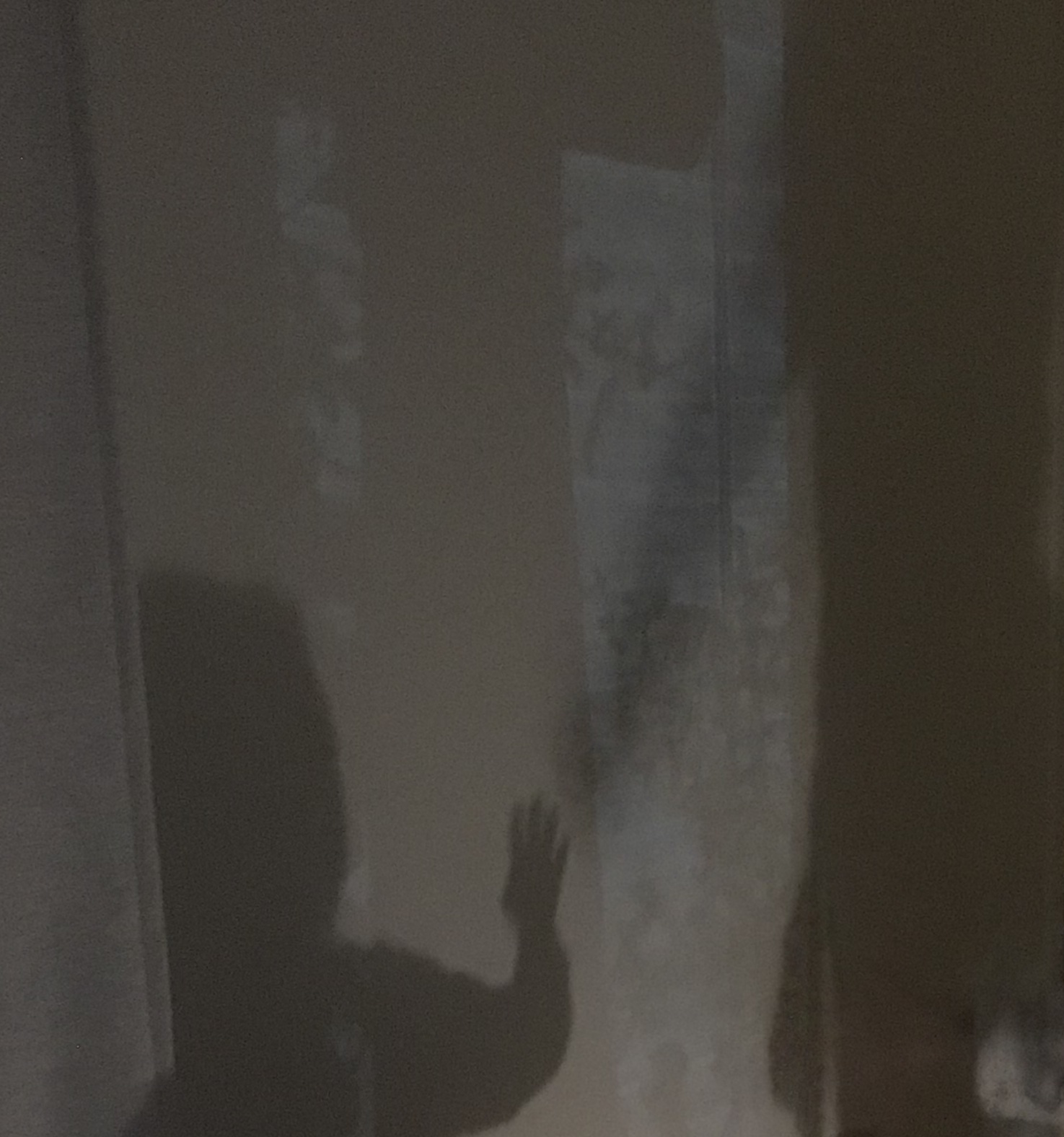
Sometimes in autumn when I wake up and make coffee I look out from the kitchen and the sky is streaked over the sea with pink and peach and purple like a crazy cocktail.  Those are good days.  Half an hour later, the morning sun shines low between the trees and the plants on our balcony and makes grey silhouetted branches and tomato vines on our white walls.  If that morning light  is bright enough and the children are awake they act out dramas of shadow bunnies and shadow dinosaurs.  

Shadow puppets

This year more than any other we know that good enough is wonderful. Boredom has become aspirational and daily life is a celebration.  In spring we put teddy bears in our windows and waved at unknown toddlers on the path who had stopped their parents and were delightedly pointing out our own teddy bears to us. This week Sanna and I decided we will make small lanterns and hang them in our windows.  Even if we can’t see the toddlers in the dark outside, I know they will be there, because at a different time, my children will be out walking a dark path in a strange autumn.  I want those unknown toddlers to know that we have left a light on as a promise that we will be waving at them again, come spring. 

How am I British?

Budleigh

The first person I heard telling me that I could not be both British and Finnish was a prospective Conservative MP in 2009.  It was at a work event that had turned into a long lazy evening of summer-time drinking.  I was used to being professionally bi-partisan, and it was a charming evening with the sun setting over the mellow brick of one of London’s storied members’ clubs, and someone else was buying the drinks, so it was intriguing to find out how different my worldview was to his.  Labour was in power and had been for a long time.  Gordon Brown was exercised over problems to do with national identity which seemed rather academic to me, even though my organisation had been a bit involved; organising the launch event for Lord Goldsmith’s Citizenship Commission and going to meetings about the proposed “Statement of British Values”.  In retrospect, I see it was in the air.  I asked the future MP what had drawn him into politics.  “Well, in one word,” he said, “if you really want to know – MargaretThatcher”.  He continued to be adamant that it was literally impossible to be loyal to two countries at once.  I wasn’t worried or frightened that he and his like would change my life, or my standing in either country.  I saw nationalism as an interesting debate but one on the fringes in a nation with much bigger fish to fry because of the financial crash.

Seven years later, I woke up the day after the British had voted (narrowly) to take Britain out of the EU, and Nigel Farage was on the radio declaring it a ‘victory for decent people’.

So I was wrong about the importance of nationalism in British social life.  Nationalism played out differently among different Brexit voting groups.  The racism of the man who yelled at one of my relatives in a hospital is different to the protectionism of the trade union leader who said that his job was to protect British workers (forgetting that his union happily accepted subs from EU workers in Britain).   But when people on both left and right talk about sovereignty, what can they really mean except that their vision of the nation wasn’t being fulfilled?

Being both British and Finnish, the debate affected me differently to pro-Europeans who were only British.  I would remain an EU citizen despite the vote, whereas their rights are being stripped away.  But I felt my sense of belonging, of having a home, or homes, had been pulled out from under me.  I mulled a lot on what patriotism meant, how to think of my relationship to Britain while also being from somewhere else.  If not an ethno-nationalism of saying “the people here are better”, then what was it?  What did Britishness mean to me?

It was definitely landscape – the Yorkshire moors, the Scottish mountains nosing at the sky, the fields in Devon rolling towards the the fishing boats pulled up on pebble shores; the narrow old streets of London opening onto plazas of glass and steel tower blocks, and people from all over the world streaming through our streets.  And it was the food that came from these places: the fish and chips, the ploughman’s lunch with a  block of crumbling cheddar, and also the food from all over the world that those city dwellers had brought with them.  Britishness for 500 years had been exploratory, outward looking.  Not always to the benefit of those people Britain had looked outwards to, but that curiosity and ambition, both good and bad, had led, I  proudly thought, to Britain’s fairly decent foreign policy and its international aid programme.  In spring 2017 I stood watching clouds and sunshine chase each other over Glastonbury Tor, and thought  ‘Britain, such a beautiful country full of delightful, polite, people who make terrible decisions.’

And, to me, deeply, Britain was in its language. English (I don’t speak Welsh or Gaelic) – that wonderfully absorptive language, full of Latin and Greek and French and German, and loan words from all over the world.  The ketchup on my chips had come via Malaysia, once.  I studied English Literature at university and could never quite believe I was getting a degree for something so lovely to do as read books.  I engaged passionately and traumatically with reading.  I cried after my Medieval exam because I felt I had not been able to fully do justice to Sir Gawain and the Greene Knight, and spent much of that summer lying on the lawn meditating on the Middle English teutonic word ‘draumr’ meaning ‘joy’ which gave us our modern English word ‘dream.’  I nearly went mad dreaming my way into Ozymandias and felt I had tracked some important thoughts about post-Providential Victorian narratives through Shelley to George Eliot.  Twenty years later, for much of the summer of 2016, I hugged this thought to myself.  I was sure Nigel Farage did not love English literature the way that I did. It made me more British than him, in my head, for a while.  I felt that love gave me rights. I had a distressing moment on Twitter when Leavers Daniel Hannan and Douglas Carswell quoted Pied Beauty by Gerard Manley Hopkins at each other over a photo of a landscape.  It was the poem my sister had read at my wedding.  They were on my turf.

There is something to say about what it means to be a re-migrant to Finland too, but I am still in the middle of that.  The only thing that has become clear in recent weeks is that Brexit or no Brexit, I cannot lose my Britishness.  People divorce their spouses but they rarely leave their children (my biological father did, but he was a shit).  For most people, there are ties that are too profound and too intertwined in everything about them to break.  My ties to both my countries are that.  I have two children, my love for one does not displace my love for the other.  The senses I have of both my countries sit happily inside me, they are not in conflict, whatever the future Tory MP thought about it. He was, I have realised, quite simply wrong.

A couple of Saturdays ago I was late to a friend’s baby’s first birthday party here in Helsinki. I explained my truthful reason for lateness, that my baby had been wild-eyed and screaming for 24 hours since a bad flight from London – but I was touched to find people ask me in reply if I had been able to watch the Royal Wedding, as if gently allowing me to reveal the truth behind a little white lie, making space for my Britishness.  And I had indeed watched the wedding on my phone on the tram, sobbing a little at Meghan Markle’s beauty as she entered the church, weeping quite freely on public transport during Bishop Curry’s rousing address about how love could change our world.  I’m sentimental about weddings anyway, but I’m sure that there was something about the Britishness that pulled me in.  The beautiful spring weather, the arches of flowers over the antique stone chapel, Britain coming face to face with our new bi-racial campaigning feminist American actress Duchess, revealed from under her magnificent veil which had been embroidered with symbols of all the countries of the Commonwealth – and a Californian poppy, for her.  We didn’t know before now that the Queen’s Prebendary is a black woman – the Church of England has been changing for a long time but now the world knows.  When I became British I had to swear loyalty to the Queen and her heirs, and I’ve never been sure what that meant.  But when I read the next day that Piers Morgan in the Daily Mail was warning Meghan off from talking about feminism from the palace, because she has servants there (as if he ever cared about intersectionality before) I felt a call inside, saying “find me my sword of words, I must fight with my Duchess!”.   Britishness evolves, and will continue to.  It’s a thing of wonder, complex and rich.  A few weeks later I lay on a hot afternoon in a hidden little corner of a Finnish forest against a smooth granite rock, amid birches and rowan blossom and the white flower called Solomon’s Seal.  It made me think of Bishop Curry’s words about love at the wedding from the Song of Solomon: “Place me like a seal upon your heart”.  I felt drenched in sunshine and love and language, and extraordinarily happy.

sdr


Block

I haven’t wanted in the past to write a blog about personal resilience, as it seemed self-indulgent.  Yes, lining up the pace of the course against client demands and life with a toddler can be hard, but it’s a choice I made.

But this morning, for the first time in my life, I had writer’s block.  I thought writing up the dissertation report would be the easy bit.  I’ve written and re-written hundreds of documents at speed, to demanding standards, throughout my working life.  But this one is different, because it signifies the end of the course.  It doesn’t quite, actually, as there is still an e-module to go, but in terms of the self-directed piece of the course, the bit where I have tried to find the subjects that would put rocket boosters under my career, this is the end.

It’s a perfect early summer Sunday  in London and my husband is taking our daughter to an outdoor swimming pool.  I am looking forward to having my life back.

The wordcount looms over me.  I have no trouble spinning words like yarn, but identifying the 15 – 20  key statements that form the core of the dissertation, that will be hard.  I gave that a go last weekend – I used Anthony Haines’s report planning  tool to force myself to say in one page of boxes and arrows what it is that my dissertation is about.  I have a catch up call on Wednesday with someone from the industry whom I interviewed, and wishes to hear how I’ve got on.  The timeline, and the world is urging me to more specificity.

But to be specific requires acres of background.  I am sitting with my 30 pages of extracted quotes from the literature review, with my transcripts floating ethereally over my head, with notes on methodology.  I have to catch sentences from the air and truncate them, squeeze them til their meaning comes out in one short gasp, not several long, flowing lines.

I proofread my husband’s latest blog last night and he admitted that his punctuation can be baroque.  He’s lucky though, he’s a scientist.  He has been trained for clarity.  The last time I was in academia I was studying Creative Writing, and before that, English Literature.  I trained my mind through work to be precise and concrete, to spout clichés to staff like ‘what we need this document to do is tell our donors WHAT we are going to do and HOW we are going to do.’

I was foolish in the process of my dissertation. I let myself enjoy exploring a new world.  But that is not what study is for, that is what life is for.  Study is for the disciplined pursuit of a well-reasoned methodology, in the interests of finding an answer to a tightly defined question that should be useful to a well defined group of people.

This is only for a few more months.  A few years ago, after 10 years of physical inertia, a friend persuaded me to run a half-marathon.  I did not do well. But I finished.  I can draw on my Finnishness, on the Finnish ‘Sisu’ – the ability simply to persist.

The writers’ block should have gone now.  I need to write down one of my sentences and squeeze it till the meaning pops out in one gasp.

It was never about the money, really. Only about what it did.

Some of my  family asked what I thought about the bad news at my former employer Save the Children, so here is what I think.  The recent news is that Save the Children has stood down from applying for DFID funds, as I understand it, to earn back trust following the disgrace of the sexual harassment scandal involving Save’s former CEO and his former Deputy.  To me, that’s like standing down every doctor and midwife in a busy hospital because of what happened in the CEO’s office.  Different punishments would have been possible.  However this is the one that is happening  and it’s not for me to say whether it is right.  But all the press talks about is the loss of £100 million a year, and not what it does – so I want to add a little drawing in the margins to show what it meant to me.

I ran a team that worked with country and technical expert teams at Save the Children, and cutting the jargon, we pulled together bids for large and complex programmes and helped them start up.  So I feel very sad that Save will have to sit on its hands next time it sees an opportunity to save children with DFID funds.  For some, this seems a peripheral issue, what are a few bids here or there, that’s just money.  But the programmes that we got funded really did matter and I wonder who will really pay the price for the transgressions of the men at the top.

The UK public often has a perception that there are a lot of development NGOs and that the market could probably be culled without too much damage.  I think that perception arises because public fundraising in the UK is indeed frenetically competitive – however the globe is big and the distribution of NGO activity across some parts of the world can be pretty thinly spread out, especially in conflict affected or very remote areas.  Save  had made strategic decisions about focusing more on exactly those fragile regions.  Not every organisation could make that decision, as if you don’t have the networks, legitimacy, and security systems to work there then you are taking risks, at worst with peoples’ lives.  But those that can, like Save and Oxfam, felt that they needed to support people in those places.  So if Save and Oxfam cannot be funded to do work, there are certain districts or provinces where it is extremely unlikely that any other organisation can step in, certainly not with any speed or scale.

There were times that we at Save were really uniquely well-placed and I have no doubt that lives were saved by our work because we were there.  I won’t identify specific programmes as I do not speak for Save, but just one example I know well.  In Country X, we were one of only three organisations present in the region where most child deaths were happening, and where an opportunity arose that would enable us to treat 100,000 child patients a year for acute malnutrition.  One of the other organisations was smaller than us but we worked closely with their excellent experts to harmonise technical protocols and agree how to coordinate our work.  In the acute malnutrition programme Save had worked on jointly with them, we had a 90% cure rate. The third  organisation in the region had a 50-60% cure rate, and although they had other important strengths that we wanted to see deployed, you can imagine how strongly we felt that the approach with the higher cure rate had to be the one delivered – you can do the math yourself on what that means with 100,000 seriously ill children.

The nutrition advisor told me how she used to go up and down the queue outside the clinic, among women queuing with skeletally thin children in their arms in hot, dry air; and she would look for the children who were hours rather than days from death and get them to the front of the queue for therapeutic food treatment.  Oh fuck, I thought. We wrote in sophisticated technical language but it was oh fuck oh fuck oh fuck  that drove the work.

Actually, we brought all three organisations together, and got over the tensions to become partners.  The overall programme we were part of was worth about £45m and we helped shape the whole, it ran on a plan that we sat and bashed out with some aggression and fierce honesty.  It would have been easier to ‘know our place’ and ‘stick to our knitting’, implementing what someone else told us to, but it was right to speak out for children.  Those were our values.

A lot of money?  Yes, it needed money.  But the bit that momentarily floored myself and my colleague Joe, walking down the steps after it was signed off, was saying that it was likely that 100,000 children’s lives would be saved over 4 years.  And if the world had another 80 programmes at that scale, mass child mortality would be at an end.  Of course it doesn’t really scale like that but never before had I worked for an NGO and seen the resolution of a global challenge within that achievable order of scale.  That country changed me, it made me profoundly optimistic about the future for a while. Over the next few years I was privileged to watch my growing team work with our colleagues on education, livelihoods and health programmes that would reach many tens of thousands of children more.

I wish people in NGOs talked about impact targets instead of fundraising targets.  We did talk about results and quality but in NGO-world if you are successful in securing large amounts of money, people assume you are driven by money. But, no, not really.  It was never about the money.  It was only ever about what it did.    And that’s why I believe that it’s a tragedy that Save is not going to be turning DFID funds into therapeutic food, science equipment for schools, making orphanages safer, helping refugee families to survive, and all the other very many things it does for children.  I hope that this period is short, and that it can get back to its job of transforming children’s lives very soon.


Tomorrow

Tomorrow I start to leave Harris.  He goes to daycare, to the ‘soft start’ where I watch him play and hope that he seems normal and acceptable to the nursery staff and his peers.  By the end of the week he will be spending hours  without me.  The nursery think this will be traumatic for him and me, but largely they are wrong.  He will mind, a bit, but he’s a happy child who likes socialising, he will find rewards in his new days. For me, well – I have been a fiercely loving but ambivalent mother.  The real me was in many ways at work: Essi was in the analysis and the balanced decisions, she was perhaps sometimes hard-to-like but fair, and effective, people said nice words like ‘integrity’ and ‘high-performing teams’. Motherhood swamped me in the ceaselessness of its demands, the emotional whirlpool of unconditional love and curiosity and concern and boredom and loss.  Loss of friends, whose friend Party-Essi had gone underground and not in the underground party way.  Loss of faith in the world of work from everyday sexism such as the interviews at the Climate Group where they asked me twice how I would manage the (risible) travel demands of the job while having a young family.  Loss of interestingness – moving to Finland and our new friends asking my husband what he did at work, whereas my role was obvious, nappy-filled and devoid of potential.

I cannot wait to hand my beloved child over to near strangers and find myself again, to write up the presentations I have promised various people, to write as many letters as it takes to convince someone to pay me again for being work-Essi and to develop my Finnish past this language I acquired as a child based on my grandmother and things my mother remembered and puolukka, juolukka, mustikka, berries, ask me anything about berries and I will reply in Finnish.

I am now up against the State for a while, as my motherhood grant ends and I apply for jobseeker’s allowance, a much more questionable and suspicious being in the eyes of the State.  Mater certa, Jobseeker incerta.  Am I really a jobseeker or a lazy-ass scrounger determined to find a way to freeride and freeload and cause anarchy in this place that depends on a fine balance of work to create its welfare.  The kinds of job I can do don’t even feature on the drop-down menu.  I do not know forestry or asbestos clearance nor am I a teacher or a technology manager.  The 10 digit me that is my personal identification code is in 1996 again, being told by a temp agency hack that ‘the trouble with you is, you’ve got no skills.’  And the one person in the world who is completely and blithely assured of my value who cries for me the way he cries for reasons as fundamental as hunger or loneliness, has no say.  Think of the reference he could provide for me.

The indomitable food provider, forbidder of bins, gatekeeper of the noisy saucepans and wayfinder in the great outdoors.  Plus of course all the roles he does not see, the Listmaker, Button sewer, shopper and parcel collector, medicine remembrancer and hygiene monitor, social support seeker and offeror, place-maker and family activity resource, walking google map for child-friendly toilets. He does not know what will happen this week.  The closest relationship he has ever known, the relationship which overwhelms all others in his need for our closeness, our staring into each other’s eyes, joint exploration of a cardboard box, is changing.  He wouldn’t want it to, although nobody has asked him, and I am ambivalent.  That’s my cardinal quality, ambivalence.  And he has no ambivalence – he wants, or he doesn’t want.  And tomorrow, he doesn’t know what it will bring but I do.  Tomorrow.

Energy, demand reduction (2): an Airbnb for energy?

A while ago I blogged about a Policy Exchange event which had encouraged people to pitch energy policy ideas.  One of the ones I liked was of enabling trade in ‘Negawatts’, pitched by Dustin Benton from the Green Alliance.  This one takes a bit of background, so bear with me.

The idea of ‘Negawatt hours’, according to this article in the Economist came from Amory Lovins, who one day noticed a misprint of ‘megawatt hours’ and used it to name his idea for a theoretical unit of ‘avoided energy’  – energy which would have been consumed, but was avoided due to energy efficiency measures.  If I do not use a Megawatt hour of energy that I could have done, that can be called a Negawatt hour.   According to the Economist article, energy efficiency was saving more carbon for the US in 2014 than all the investment in renewables combined.   Further, Negawatts can help deal with one of the challenges with renewables until someone really sorts out solar and wind batteries, which is that these sources are  intermittent and not enough to cope with peak demand.  If people were incentivised to avoid using energy at peak times, it would reduce the demand for dirty energy and possibly the need for entire dirty power stations that are only kept because they are needed for the peaks.

Dustin Benton’s pitch was to enable consumers to sell their negawatts back to the grid.  By way of illustration, my family doesn’t watch football but most of the UK will watch a big match and put their kettle on at half-time.  That uses up all the renewables on the grid and more, so the grid tells the diesel generators to crank up.  If it just so happens that my family are enjoying a walk in the park with no crowds (everyone else is watching football), then the grid can use the energy I might otherwise have been using at home, and give me a little financial reward.

Making this work would depend on a lot of granular data collection and smart metering; and possibly on some quite tricky upfront calculations, like what the standard energy allowance should be before Negawatts could work.  But it could be quite fabulous.

Later, when I was wondering how to initiate  small-scale trading in a currency people don’t think about much in their daily lives, I imagined it being marketed as an ‘AirBnB for energy’.  I could see a very soft focus advert with a pair of people, where one is having a party and the other is reading a book by a sunny window.  The book-reader is selling her Negawatts so that the party hostess can switch on fairy lights and heat up some birthday cake.  Like AirBnB, it’s not really anything to do with sharing, it’s much more about micro-transactions – but I think the communal aspect, helping other people live their lives to the full, is something that would sell. People often don’t think that much about energy, but they think a lot about the things it provides – warmth, cooling, light, comfort, entertainment – and from those things we build up fun times, cosy homes, great shared experiences. An AirBnB for energy would bring people in by selling those experiences with a side order of cash benefit.

There are already companies starting to link the small-scale in energy, like:  Vanderbron in the Netherlands: https://vandebron.nl .  We are getting the technology in place to do much more with such very small transactions.  Then once a primary market in Negawatts is established, the geeks in the City can do their thing too and think of ways to sell Negawatt derivatives and goodness knows what else, and that will keep the high-rolling capitalists on board with the idea.  There is a bit of a conceptual jump involved with Negawatts  – but if the City can borrow shares it doesn’t have in order to buy them when prices fall, I think we should have the ingenuity to be able to trade Negawatts.