All posts by EssiMaria

What should I do after Britain’s EU referendum?

Stop no right turn

I cannot remember a darker week for British public life than this last one.  This blog is not directly about Jo Cox, the brilliant MP and passionate campaigner, who was murdered in the course of her duties by a man who gave his name in court as ‘death to traitors, freedom for Britain’. But of course it has shaken me deeply.  A politician was targeted and killed in the course of her duties: this is shaking Britain.   I never met Jo Cox, but have worked for the same charities, and read with admiration her writing and speeches: she was someone I saw as a leader on issues I care about.  My first thought when I woke on Friday morning was of her family, and what waking up that morning would mean to them.

A piece I admired a lot was one that Jo Cox wrote on Syria together with Conservative Andrew Mitchell.  As I have got older, I am less attached to party loyalties. What I have seen is that where something really matters, the best chance of a lasting result is in cross-party political consensus.  Here, in Jo Cox and Andrew Mitchell, were politicians showing that they cared more about what happened in Syria than they cared about scoring points off each other.

Jo Cox also said:  ‘What surprises me time and time again as I travel around the constituency is that we are far more united and have far more in common with each other than things that divide us’.

I tried to get more involved in the Remain campaign but was defeated by the weight of work, study and my pregnancy.  My body shut down every time I tried to push myself to do more.   But the death of Jo Cox has made me feel that there is more I should do, soon.  I have not tried to challenge and comfort the cynicism and despair when friends on social media said politicians are corrupt,  all in someone’s pocket.  I could have found examples of politicians who are trying to make it better.  I have not been encouraging enough when friends have found ways to act out their values, and make our places and relationships better.

Part of what holds me back is feeling vulnerable.  I have a young child and am pregnant, I feel alarmed out campaigning when a big man towers over me and shouts ‘I’m voting OUT, come to your senses!’ I’m a dual national, and one of my oldest friends voiced her discomfort with the idea, saying that dual nationals were looking at both sides to see where to get the best deal.  I’m easily intimidated and get confused if I feel personally drawn in.  But I have to say this anyway.

It may be that next Friday, June 24th, it will fall to those of us on the Remain side to accept a result we have been dreading, to swallow our bitterness, and to search internally for the strength to get on with helping to build the future.  This does not mean that we should accept that all the things we fear must come to pass. I will definitely need the NHS in the next 6 months and my daughter will start school in a year.   As someone who depends on public services working, the economic shock will impact on me and my family.  So it will fall to people like me on both sides, to try to make the system work under the new, unwelcome, dispensation.  As my husband said last night: ‘The job is, always, to try to make things better.’   We will continue to believe in democracy but we will also be clear that we think the Leave campaign, if it wins, will have won largely on the back of misleading statements about money and on a terrible platform of fear about immmigration. A Comres poll showed that Leavers are more likely to believe that man-made climate change is a made up scare story, and to distrust scientists. We will need to argue the case for science and for a better direction of travel for the climate, among many other tasks.  It will be unwelcome work but we don’t have a choice.

On the other hand, if our side wins, what then?  We will be hugely relieved, but we should not over-celebrate.  We should not use that phrase ‘this is a victory for democracy’ when, vilely, we mean only that ‘our side won.’  (Equally we should not call a Leave vote ‘a sad day for democracy.’  Democracy’s sadness or happiness is not tied to a particular result).  It should fall to us who voted Remain, if we win the vote, to hear the many voices on Leave which were not racist, but which worried about housing, jobs, services, about the health of our democracy.  Many Leavers have the same worries that I do.  I cannot share their conclusion but I can share their concerns.

For all our sakes, let’s not exhaust ourselves with bitterness before the 24th.  Let those of us who believe in democratic process, dialogue, civility, citizenship education, on all sides, find the strength to help each other continue to believe in those things, even when, especially when, we have had our hearts broken.

Community orchard


In Memoriam Salli Lindstedt

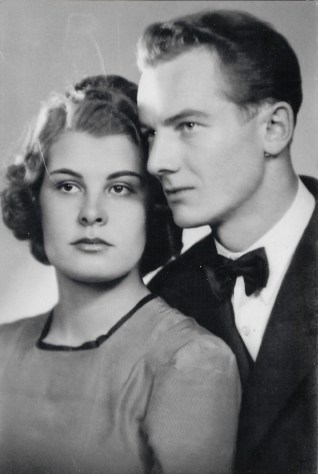
Salli and Erkki

In memory of Salli Lindstedt:

26.09.1926 – 27.05.2016

Every so often, I think:  ‘I wish Salli-Mummo could see this.’

Today it was when I stopped at a small Korean restaurant for lunch.  It provided lovely food, there was modern Korean photography on the walls and modern concert music playing.  Salli never told me that she wished she could have travelled outside Finland, but when I came to visit her and Erkki after a trip to Kenya, she took away my old, formal school portrait, and replaced it with a snap of me, dishevelled, making morning tea on a camp fire in the Rift Valley.   Once, as two boys slid rattling below her window on skateboards, she said enviously ‘wouldn’t you like to do that?’  At the age of 24, I didn’t, but at the age of 70, she clearly did yearn for that adrenaline and freedom.

My relationship with her was close, because as a child I spent a month of every summer with her.  I marvelled then at her busyness, at the incessant round of shopping and food preparation, with  a break after lunch to read the paper, and then on again with a whirl of activity, a bucket of strawberries to stew into ‘soppa’, clothes to put through the mangle, an elderly friend to visit.  She taught me rural virtues, like duty, and not wasting anything, especially food.  If I was displeased with my dinner, she reminded me that when she was small, they had to put birch-bark in the bread to make it go further when the crops were failing.  She took me to stay in the old farm-house near Kemi where she had grown up with her 12 brothers and sisters. If I complained about having to wear unfashionable cast-off trousers and getting covered in bird poo on a day’s berry picking, well, it was either funny, lucky or character building, depending on her mood.  But every morning when I woke, she had already been out, fetching water from the pump and picking bilberries to put in my porridge. She showed me how she wove rugs on the loom in the unused parlour. We visited her mother together in Simo, in a care home where Kaarina lived with Alzheimers and cared comfortably for a doll in her lap.

Part of Salli’s duty to me, and hopefully a pleasure, was to expose me to culture as well as to feed me and make me virtuous and frugal.  We visited the library at least weekly, and sometimes went to concerts, and perhaps once a summer she took me to the spare, plain, wooden cathedral in town, where I acquired no knowledge of religion but learnt to be politely and discreetly bored, an invaluable skill.  Of course, most of what she taught me about culture was implied.  Implied in the few but excellent objects in their home: the paintings on the wall, the classic Finnish designs of glassware and ceramics that we ate from, the classic novels and the encyclopaedia on the book shelves.  She had not had the opportunity for higher education herself, although she had gone for a few years to the small village school, but she had fine taste and an easy capacity to learn.  She may have grown up on a farm in the very north of Finland, and known hunger and Nazi occupation of their barns, but she had made herself refined.  She easily picked up sentences of English from the television.  She let me play with her make up bag when I was a child, and said to me: ‘when you are grown up, you should try to look as much like Grace Kelly as possible.’ Another time, in my 20s, when I was being nagged to find a husband, I asked her if she would mind if I didn’t marry.  ‘Of course not,’ she said.  ‘There’s no point doing something just because it’s the custom.’

It took a long time for the shadows of Alzheimers to close around her completely.  One time, visiting her at the sheltered accommodation in the flat she lived in with Erkki, I saw the newspaper out and found out that she still read the paper cover to cover every day and did the crossword.  She could still say thought-provoking things.  We walked past a rosebush, and she said: ‘for some reason, I prefer a bud to a rose.  A rose is just what it is, even if it’s beautiful; but you don’t know what a bud will become.’

Further on, she was living in a care-home with a beautiful garden.  She was widowed by then, stiff in the joints but still mobile, and brightly talkative.  I had brought my fiancé to meet her.  She had no clear grip on who I was, but her impeccable social graces let us have a wonderful conversation, and we sat and talked in the garden while she periodically twinkled at my fiancé.  I wondered if, tall, good humoured and even-tempered, he reminded her of her own Erkki.  Toby’s theory was that as he was a non-Finnish speaker, she had recognised a kindred spirit in him: someone having quite a nice time but totally confused about what was going on.  Her youngest grandchild Varpu also appeared that day, which gave Salli great pleasure.  As we left, she gripped Toby by the hand and said earnestly, ‘aren’t little girls lovely?’

Further on still, two years ago, we got to introduce her to our own little girl.  She almost certainly did not understand the relationship, perhaps she no longer had a concept even for what a family relationship was.  But she knew that there was a baby girl in a yellow dress playing on the swing, for her to watch with pleasure while she strung words together like necklaces of mismatched beads.  Briefly, our daughter had a name for her great-grandmother:  ‘Mummomama.’  To play with a young child in the sun and eat ice-cream, to talk in your own way with people who love you – that seems like a good deal to strike with the world at any time of life.

4 generations


Should not-for-profit organisations develop their own unique innovation culture?

As I was researching technology partnerships with one of my clients, I was surprised to see how frequently people raised an anxiety about whether they were, organisationally speaking, innovative enough. The rapidity with which the issue came up in conversations was maybe linked to the fact that they are among those who are already doing a lot to cultivate a culture of innovation – I know they run an internal challenge fund for example. However it struck a chord with me because I often look at new innovations funds in our sector, and see that some of the things these funds end up supporting have been around for a long time. Is it true that maybe there is not enough innovation culture in NGOs? Or is it that we need, as a community, to better define what a workable innovation culture looks like for us?

The popular model of innovation is based on the idea of entrepreneurs, usually in business, devising a new thing that consumers love in droves. There is a theory to counter this emerging from (for example) the writings of Mariana Mazzucato in the Entrepreneurial State, which identifies ways in which states provide the essential social and material infrastructure for innovation. Daniela Papi-Thornton of the Skoll Center for Social Entrepreneurship wrote in the Stanford Social Innovation Review of the risks of ‘heropreneur’ thinking and the need to support the people who have spent time up close to a problem – by choice or because they live with it. It reminds us that in NGOs, our role is often more to be the ‘first follower’ than the visionary, that our work should always be in the service of a community of people. I think it is fair to say that not-for-profits could benefit from defining their own unique innovation culture, different to private enterprise and the public state.

These are my starting points for what a not-for-profit innovation culture could look like.

Be clear that our risk/reward calculation is different than for businesses in general

A not-for-profit which work with vulnerable populations, perhaps in fragile geographies, has to make a different kind of risk/reward calculation than a business developing new consumer technology. When you are taking risks with other people’s well-being, or donor money, the risk/reward calculation is usually set in quite a different place. It is perhaps not surprising that one of the most widely name-checked innovations in development, the low-cost mobile money transfer service of M-PESA in East Africa, emerged initally from the private sector, although it always had social purpose in its DNA and has proven to be a unique platform for the development of new socially valuable programmes from a huge array of other groups. As Edgar Schein, organisational psychology theorist and Professor Emeritus at MIT Sloan School of Management, said:

‘I was struck by how different computer companies were from chemical companies because of the underlying technologies that spawned engineers with very different worldviews, concepts of time, approaches to experimentation, and so on. For example, the easy fooling around with circuits that DEC engineers reveled in would have been career suicide in the chemical environment of Ciba-Geigy.’ (Organizational Psychology Then and Now: Some Observations)

I think not-for-profits will often feel more like the chemicals company than the software firm in terms of their risk profile. The humanitarian principle of ‘do no harm’ has to be applied to innovation in not-for-profits. Organisations like the Gates Foundation which do fund innovations in health have serious standards in research protocols, in order to ensure that their work does no harm.

Acknowledge the constraints in our type of (social) businesses

Then there are operational challenges to innovation, such as the inability to free up time to share ideas, or to borrow Clay Christensen and his colleagues, the time to develop the ‘five discovery skills for innovators’, to: associate ideas, question, observe, experiment, network. Research Councils sometimes run 5 day sandpits, (innovation workshops) but I find it hard to imagine most NGO staff I know being able to take 5 days out of their jobs for something which may turn out not to help their project at all. Where staff are project funded, this is hardest of all. And our ‘experts on the problem’ – the intended beneficiaries of the innovation – are probably busy or hard to access.

However, I think there are many, many channels for innovation in the not-for-profit sector.

First off, I think there is a lot more of innovation going on than people realise. We should celebrate the innovations that our community is in the middle of developing right now. Mostly at the level of process or business model innovation rather than product innovation but a lot of the time, that’s where the innovation is needed. We have technology that is good enough for most basic needs, the challenge is getting it through the last mile. Tim Black, the founder of Marie Stopes International invented a social enterprise model for MSI back in the 60s. People are still re-inventing that model today. Or the consistent piloting of cash transfers as an aid model (instead of food aid, or building shelters for people) is producing an overwhelming body of evidence that cash transfers are effective. Cash transfers, especially if done on electronic platforms, will bring down operational costs hugely as it’s way cheaper to transmit cash than move food around. Development practitioners have proven willing to disrupt themselves and their traditional ways of doing their work.

If things like product innovation don’t flow naturally from your social business model, don’t worry about it. You’re probably doing a great job on frugal innovation in how to deliver vital services with hard-to-reach communities. Don’t worry so much, you people are good at this.

Document, reflect and share your work

Secondly, and this is my biggest one, even if management is hardass and don’t really believe in toilet breaks as long as we’ve still not solved world hunger, quickly document your work and get feedback. Reflect on it. There may be innovations in there that you can’t see yourself, or that only become obvious after a year of implementation has kicked them into shape, like the camels carrying solar powered mobile pharmacies my colleagues devised at Save the Children with a partner organisation in the Somali region of Ethiopia. It was a great example of frugal innovation I thought – applying an existing technology and an existing – er – camel – to the problem of health services for nomadic populations in terrain where sand regularly chews up jeeps.

It doesn’t have to get written up in the Lancet to be valuable. It could be a relatively small problem that you solve, but share it. Who else is having that problem? If you or someone else fixed a problem, however small, and 10,000 people are having that same problem, actually you could be fixing a medium-to-large problem before you know it. Sometimes even carefully and thoughtfully delineating a problem can help someone else working on it to understand it better.

So in summary: Stay aware of innovations in our community; reflect; write up and share your cool problem-solving stuff. That’s all I’ve got for now. I am sure I have missed many important points and I welcome your contributions to this discussion.

Using personas as a research tool

I was discussing the challenges of interviewing people as part of a course on ‘sustainability leadership’ with my supervisor, Dr Jonathan Chapman, Professor of Sustainable Design at the University of Brighton. I told him how my experience was that conversations get locked down in a certain way by being framed within sustainability, and I felt that people became more concerned with giving ‘good’ or ‘ethically correct’ answers rather than just saying what they think. I also told him how I would like to ‘give something back’ as part of the interview process, even if that was only a case of making the half hour interesting rather than boring. Dr Chapman suggested using personas as the basis for the interviews.

I thought that using personas was a great idea. It would provide the necessary evidential underpinning to allow the interview to be quite unstructured, which I felt, given my intended participant group (leaders and UX designers in energy monitoring businesses) would provide a much more rich output.  I read what Martin Maguire said about the use of personas in human-centred design and inclusive design (Maguire, 2001 and Marshall et al 2013). I reflected more on the framework for understanding energy cultures articulated by (Stephenson et al., 2010) as ‘patterns of norms, practices and/or material culture.’ Then I re-read my collected literature, reviewed my analysis of the public data on energy and technology use (broken down by housing tenure, or by age and sex). Finally I took myself off to the National Theatre to be in a creative environment and wrote my personas: the ‘unusual users’ who were thinking about buying energy monitors: Tamsin, David, Rebecca and their respective households.

The ‘unusual users’ I created were based on: older people who are not highly technology literate (Tamsin); young people who are technology literate but live in a complex household energy culture (David), and a family with young children (Rebecca).

Each of those cases could represent an opportunity for energy monitor providers to increase market share or create deeper and richer use experiences.  It will be interesting to see at the end which user case is of widest interest.

I was quite concerned that I had not based the personas on my own research with real users. However the Marshall (2013) paper discussed the value of using datasets as a proxy for real users because of the shortness of time of much research and recognised the value of using existing research.  Further my main focus for the study was (in line with the CISL focus on business leadership) on finding out how the businesses producing energy monitoring systems would react to ‘unusual users’. I was also very fortunate to build on amazingly rich research such as the ethnographic study on energy use carried out by Lockton, (2014) which described the voices of real people talking about energy monitors. Other studies that helped enormously were by Hargreaves et al., (2010) looking at householders in East Anglia and their energy usage, and Fell and Chiu, (2014) who studied children and parents interacting around energy use. Further, it would be complicated to identify and access householders who might potentially be interested in energy usage. I tried to piggy back on a few locally organised energy events (an energy efficiency advice session), and a focus group being carried out by a not-for-profit group by my local council. These organisations were willing to let me come along and promote my research, in the hope of attracting participants, but the numbers interested were too small to enable me to have anything like a representative sample of users in my interest groups.  So after a lot of swithering, I felt it was more valid to have based on my personas on the work of researchers who have gone down this road before, and draw these to the attention of the energy monitor businesses.

People who are not in the habit of using internet-enabled technology

This persona is significant because of early mapping and conversations with the energy monitoring and smart meter industry, and their emphasis on using internet enabled devices (desktop computers, laptops, tablets and smartphones) as the user-interface, as well as or instead of a standalone display unit. Early conversations and media monitoring showed that accessing the energy data via an app was seen as the direction of travel in the industry.

This led to a concern for whether design would facilitate use for people who are less likely to use the internet. Government and other publicly available data demonstrated that these people were likely to be older people, or people who lived in social housing (the social housing group also had lower incomes than other tenure types).


Children and parents together

Reviewing how people access the internet, or receive data more broadly also led me to two other ways of accessing data, of which computer games, smart TVs and wearables such as the Fitbit were important for some consumers.  The population accessing the internet via computer games and smart TVs skews to the younger age group. The Fell and Chiu (2014) study made it clear that children could grasp the concept of the energy monitor (they could observe a spike in the numbers, even if – probably like many adults – they did not know what units the numbers signified). So I became interested in the unusual use case of the children and young people for whom apps may only be one way of acquiring information, and sensory signals (such as the buzz of the Fitbit or a computer game console) provide a possible design opportunity, as well as social media and gamification principles.

Sharers of a home who are not related to each other

Reviewing how people access the internet, or receive data more broadly also led me to two other ways of accessing data, of which computer games, smart TVs and wearables such as the Fitbit were important for some consumers.  The population accessing the internet via computer games and smart TVs skews to the younger age group.

Building on the Stephenson work in energy cultures, I was interested in the difference between households where this a presumed bill-payer and decision-maker, and houses with more complex cultures where there is no such authority. Some tech companies have emerged to serve such markets, eg www.locatable.com who make an ‘app that’s the best way to split bills and track costs with your housemates!’ and whose slogan is ‘we build stuff to make life a little more awesome at home’. They don’t make energy monitors but the app does split utility bills.

Giving my personas a material context

I gave my personas a physical environment, i.e. a home and a social and technological environment depending on what the public data indicated was a statistically likely tenure type and income bracket.

Reviewing the literature on energy usage, I could see that studies of people living in rented housing (whether privately rented at market rates, or rented from a local authority or social landlord) were also relatively scarce. These property types have different energy efficiency characteristics. Private rented households are over-represented amongst the most energy inefficient households compared to other housing types, but renters may have little control over the fabric of the house.

Social housing is in fact disproportionately more energy efficient, and several social housing providers are carrying out interesting experiments with ‘connected homes’ using internet of things technology. This is partly to renew their own business model: providing opportunities to help their tenants (e.g. to manage energy bills) but potentially to protect vulnerable tenants. I heard Property Tectonics speak at a conference about the possibility of spotting that an elderly tenant had not used any energy in cold weather, and being able to go in and check that they are okay.

I layered these different factors into the personas. I did not have one all-singing all-dancing dataset underpinning the personas but each sentence represented a data-point.  I felt confident that they were ‘data-rich’ as opposed to ‘assumption-based’, to use the terminology from Marshall (2013).  My expectation is that different energy monitor makers will have different angles, and not every persona will be equally interesting to every company. For instance, some might see their product as having something particular to say to the technology use angle, the child/parent dynamics angle, or the non-family household angle.

Incidentally my one area where I diverged from Maguire on the use of personas was that I have not provided a visual picture.  This was due to my ethical concern about widely sharing pictures of real children in the Rebecca persona, as it would have taken another chunk of time to explain to the children and parents how the picture would be used and to get their permission.

Hopefully the personas will produce some creative findings and lead to renewed interest in unusual users – in my dreamworld one firm will be inspired to co-design a product with children, and we’ll see children being really engaged as active and conscious consumers in their own homes. But that’s another whole study….


Books through the eyes of children

Over Christmas I read ‘Through A Child’s Eyes’ – a paper from a 1992 seminar at the British Film Institute led by the writer and mythographer Marina Warner.  Warner brings out the ways in which adults project their concerns  onto children, and through the idea of the child. Children are fascinating to readers alternately because they are innocent – the idea of a child at risk calls on our  determination to kill the witches that threaten them (Hansel and Gretel); or otherwise because they are disobedient, irrational, not yet socialised, and live (perhaps) in a world where reality and fantasy rub up against each other – children are Where the Wild Things Are and Alice in Wonderland.

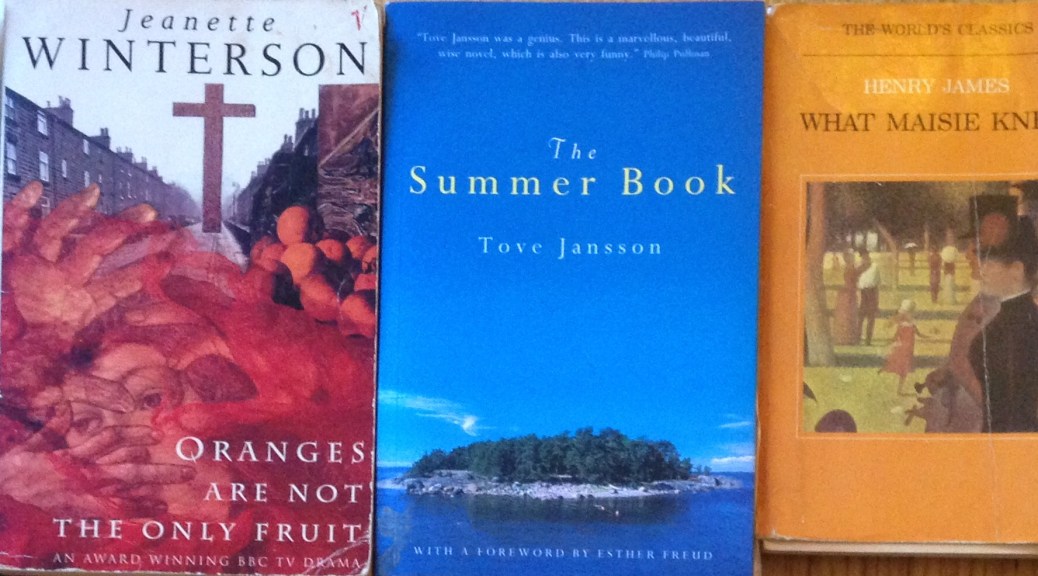
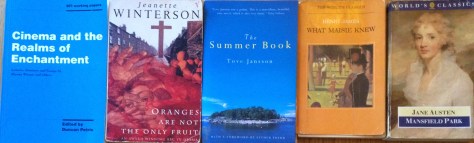
Reflecting on the essay, I realised that two of my favourite novels are seen through the eyes of displaced, off-centre children, children with losses, but they are real, or at least naturalistic children. These are ‘Oranges are Not the Only Fruit’ by Jeanette Winterson and the ‘Summer Book’ by Tove Jansson. In Oranges, the child has suffered the loss of her birth parents which is not compensated by her adopting parents, who are a neutral, distant father and a fiercely engaged, religiously fanatical, abusive mother. The tone of the Summer Book is much less traumatic – the book is comprised of a series of scenes of a child playing with her grandmother on their summer island in the Gulf of Bothnia, off the coast of Finland. But the child’s mother has died and the father is again a distant figure. The grandmother is a compensatory giver of love, fun, and moral education.

Oranges is the only novel I have ever read in a single sitting and then immediately turned back to page 1 and started again. I devoured my first reading in the hope that I would get to a happy ending, and then revelled in the second reading as with a delicious sweet. The language is extraordinary – it spills tonal and stylistic features of all the best literature in English, like a child who shows all the most interesting features of all its grandparents. It was like reading a new language – English, but more vivid. At the beginning of this year, I also read Jeanette Winterson’s memoir, ‘Why Be Happy When You Could Be Normal?’ Published 27 years after Oranges, it treads the same story, but as an account of the real childhood she remembers rather than the fictionalised one in Oranges. The book, although wonderfully written, cannot match the sheer literary brilliance of Oranges, because nothing can, but Why by Happy…? is gripping for being truer. It is horribly sad to find out that in describing her childhood in Oranges, Winterson had pulled her punches – her real childhood was much more painful even than the childhood in Oranges, and the abuse she received from most adults who should have cared for her, especially when they discovered that she was lesbian, is terrifying. The memoir illuminates interesting corners both of British social life (the racism and sexism she saw at Oxford) and a traumatic psychological journey (meeting her birth mother). In Oranges, the novel ends in triumphant mode as she comes back from Oxford to see her mother (Mrs Winterson) and there appears to be some kind of resolution at least, if not reconciliation. But In Why by Happy…? you read with real concern as the mature writer reaches, struggling, far into herself to describe the confusion of meeting her birth mother, and the psychological tearing she experiences from the loyalty she feels profoundly to Mrs Winterson, who betrayed her, but who was always there – as every child wants their parent, however bad, to be. The two books read wonderfully alongside each other as different windows into the mind and heart of a brilliant young girl in a poor Northern town – where as Winterson points out, there were mental and emotional escapes from poverty through friendships, libraries, allotments,  evening classes. A good teacher helped her get to Oxford, which for all its faults, opened up a very different life for her.  Books gave Jeanette Winterson a lifeline once and I am sure in turn her books have been lifelines to many of her readers.  Winterson’s prose is thick with line and colour, it’s like being surrounded by an El Greco painting, as the language of the King James Bible dances with the dark and the light of human passion, and kept engorged with hope by the narrator’s dogged belief that love would come to her, that belief saving the girl even before books did.

The Summer Book is a completely different kettle of fish. It  is more like a drink of water from a well – cool and sweet, close to nature. The clear and unsentimental narratives of the child Sophia and her grandmother are as understated as a line illustration, and confirmatory of the ways in which normally happy children become normally socialised.  It is minature in scope – set on a tiny Finnish island with the scenes peopled mostly only by the child and her grandmother (at most there is a visitor on a small boat or another tiny island in the waters around it).  The Summer Book creates a perfectly realised experience for the reader of a long childhood summer holiday; of Sophia’s impetuousness, of the grandmother thinking through how to balance the child’s needs with her own, their physical enjoyment of the tiny world of their island. The child has a moral education through her passions. She detests her first cat, Moppy, for  being wild and for not being  cuddling silkily in her lap, and she trades it for a lapcat, Fluff. After a week she is in despair, missing her hunting cat, which of course has been imprinted on her heart as the essence of cat, even though books or the culture around her had led her to think she wanted something different. ‘Hunt! Do something! Be a cat!’ she rages at the impassive Fluff. Similarly, she is besotted with a friend from school who has perfect ringlets of hair, but when she brings her friend to her island, she finds her terribly boring, and the friend’s departure is a relief in a way that I remember from my own Finnish childhood – perhaps it was an echo of leaving school and smelling the fir trees growing on the edges of the small town, being able to hunt down some lingonberries without a social convention breathing down my neck. Sophia learns that her passions must be acknowledged and understood, but also that she must behave in civilised ways, and treat people decently. She learns through freedom, but also through the consciousness that she is observed by the loving, boundary-setting, consistent gaze of her grandmother. I’m sure most Finnish expats have a copy of the Summer Book. It expresses many things from Finland but that evocation of the tension of being torn between the wild and the domesticated moods is the claw with which it sticks to my skull.

Marina Warner refers to What Maisie Knew by Henry James as paradigmatic, as one of the first novels to tell a story focalised through a child. What Maisie Knew is an incredibly sad novel from the 1890s about a child whose divorcing parents fight over her custody in order to punish one another. Like so much of Henry James, it feels written for today, not 120 years ago. But there is another earlier novel which I think focalises through a child, and that is the first section of Mansfield Park by Jane Austen. Another displaced child, Fanny Price, is taken away from her poor family to the house of her rich relations, in order to be useful to her Aunts. The family congratulate themselves on their benevolence, but in fact her experience is of emotional and sometimes physical neglect, and some cruelty from her Aunt Norris, who in one episode leads Fanny to become physically ill. The emotional coldness of the family is given expression in the way in which she is socially isolated and left to herself in the unheated nursery that the bullying and self-centred children of the family no longer use. She sits in her quiet space, not much loved but at least not tortured by unappealing conventions, and reads herself into adulthood – as Sophia perhaps might have been required to do, had she not had an excellent grandmother.

Fanny Price has not been a popular Jane Austen heroine. She is not a transgressive heroine and therefore gives little pleasure to many of her readers. Marina Warner references this (p44) – the tendency of adult readers to enjoy reading about rebellious children (whether they were rebellious children or goody two-shoes themselves). Books about rebellious children satisfy the wishes of unsatisfied adults to read about rebellion. Many adult readers do not empathise with Fanny’s loss, or her anxiety about her new home. However if Fanny’s life is seen through the lens of a physically frail child who experiences neglect and who is constantly undermined by her Aunt Norris and cousins Julia and Maria and yet survives: emotionally, physically and morally intact; then her life is one of achievement. Her good cousin Edmund takes an interest in her, and vitally, gives her both books to stimulate her mind; and pen and paper to enable her to correspond with her beloved brother William, consoling her heart. Fanny builds a morally well developed world view as a result, and when that is challenged, as it is when even Edmund is half-seduced by the attractive but selfish Crawford siblings, Fanny remains true to her principles, even though a return to poverty is threatened for her. Like Jeanette Winterson, Fanny is morally saved both by books and by recognising what she loves – first her brother William and later, Edmund.

These novels do more than work along the curve of the archetypes of children in literature identified by Marina Warner. They give the experience of children the weight of humans, not toys or plot props, or  adults-in-waiting. The children are complex and sensitive in their own right. Through the eyes of an individuated child character, the novelists do indeed illuminate something about our concerns, but the gaze comes from the child and looks at the world, rather than the child’s eyes being a mirror for adult anxieties.

 
Cinema and the Realms of Enchantment, Lectures, Seminars and Essays by Marina Warner and Others. Edited by Duncan Petrie. BFI working papers, 1993

Oranges are Not the Only Fruit, Jeanette Winterson, 1985

Why Be Happy When You Could Be Normal?, Jeanette Winterson, 2012

The Summer Book, Tove Jansson, 1972

What Maisie Knew, Henry James, 1897

Mansfield Park, Jane Austen, 1814
Books2

Energy, demand reduction, and who is going to get me some nice lightbulbs?

Green energy people in the UK didn’t have a comfortable summer despite the sunny days, with unpleasant surprises like cuts in Government financial support for solar energy generation.

The new direction from the UK Government is to help people reduce their domestic energy costs (and maybe carbon), without costing the Government any money.  At the same time policies must keep businesses on board, and win public acceptance. Enough of a challenge to keep anybody busy.  Energy efficiency as a strategy to resolve that cluster of problems is therefore, in policy land, the site of big hopes.

I heard some great policy ideas recently to help people consume energy more efficiently. One I liked a lot came from Simon Roberts OBE at the Centre for Sustainable Energy, pitched at a ‘Dragon’s Den’ event at the Policy Exchange thinktank in London. The idea stood the idea of supply and demand on its head.

Simon proposed a ‘Demand Reduction Obligation’ (DRO) to be put onto energy suppliers, i.e. the Government would set targets for energy suppliers to reduce the demand from their customer base. The idea has the beauty of being both simple and radical. It is simple because it sets a desired outcome without being prescriptive about the means. It is radical because it sets businesses free to build new types of service, new types of customer relationship, and new types of management system. It could free up demand for technical innovation in energy efficient products, social innovation (social marketing of energy efficiency) or most excitingly, business model innovation. That’s why it stands the idea of supply on its head, because it is mandating businesses to sell less of their product – with the implication that they need to find something else to sell.  Perhaps most businesses will not welcome an obligation to sell less of their product. But a few business leaders may see it as an opportunity to give their business a new direction, perhaps carving out a niche within circular economy principles or taking up a service model.

The implications for consumers become interesting. If you are a low energy user, you could find yourself courted with great deals as energy companies seek to entice you over to keep their portfolio balanced. There might need to be some smart profiling – for example, private rented housing is likely to be much less energy efficient than owner occupied or social housing, but the data is there to create fair DROs for suppliers. And you would need to make sure there were no dwellings that nobody would serve.  But the idea could be really exciting for sustainability leaders in the energy supply business, and for  consumers.  Maybe some particularly energy efficient consumers could become entrepreneurs themselves, trading their abilty to avoid using energy at peak times with people who have to feed the whole family and put the washing on between 6-8 pm.

When asked what energy suppliers should do if not supply energy, Simon Roberts proposed that one shift would be to develop businesses such as ‘LED lightbulbs as service’. At the moment if you want low-energy lightbulbs you can’t have the pretty ones. The vintage-type ones that look like someone’s been waving a sparkler up and down inside a lightbulb, are F rated. The plain, functional, virtuous LED ones are A+ rated.

Imagine a company that not only reduces your lighting costs but offers a range of nice lightbulbs as service, maybe identifying where your family needs different kinds of light, or maybe with a winter special of warm-glow lightbulbs swapped with cool bluer bulbs in summer.  That’s the sort of thing that could make energy efficiency inspiring to people as home-dwellers, not as bill-payers.  As people at the Policy Exchange event kept saying ‘people are not spreadsheets’ and yet that’s how energy efficiency is marketed. And as a result, people for whom status and luxury is more important than cost, are one of the groups stubbornly failing to make energy efficiency savings.  Cost is a huge driver of consumer behaviour, but it is not the only one.  Making life more inspiring can go hand in hand with living more efficiently and sustainably.

A rare example of a pretty LED lightbulb, by Edison. 


Homes, wifi and energy culture

In my last blog, I described my difficulties with my home energy monitor, My Not So Wise Owl. I felt very ashamed of myself as I was writing. I thought I must be dim-witted as well as increasingly dim-watted.  But in fact I am not a corner case and smart energy monitors have not yet (as far as the literature can tell me) won hearts as well as minds.  A wonderful study: ‘Making Energy Visible’ by Hargreaves et al, 2013, (1) documented the tangle of hopeful starts and frustrated endings of smart energy technology products in the home.  Having curbed an energy bill by perhaps 5%, they lose their usefulness and appeal, and end up stuffed away in a cupboard, out of sight and out of mind.   The Financial Times summed it up this week with an article headline saying :  ‘The smart home is still too clever for its own good.’   The family roles and conflicts documented in part in Hargreaves et al, are acutely pictured by the satirical comic ‘the Daily Mash’ in their article: ‘Dads begin obsessive relationship with thermostat.’

My motivation for my research on smart energy devices in the home (2) comes in part from my fascination with the cultural significance of the home. I have for the last year wondered whether a culture of sustainability actually exists, and if so – is it something like a social movement, or more like a life-style interest (like gardening or cooking) or is it ultimately only a policy intent from various different people? It speaks often, from the perspective of the UK, about a crisis for people in other places, or at other times.  Sustainability is not yet the water we swim in.

Cultures in politics and business are readily observable. Even where our own biases blunt our sharpness, there are enough witnesses  for some consensus to be created about what is happening, and what should happen. When we discussed gender diversity on our course, nobody said that actually mothers in the workforce are a costly drag. But I’ve heard that said in actual workplaces, or rather heard that it was said, and reported to me by my mole from an all-male room. Cultural norms and peer pressure play a role in building a consensus, at least in polite (and mixed) company.

Homes are very different. People do not (and should not) feel obliged to behave as though there is external scrutiny of their actions at home.  The culture of the home is private.  The web of pressures and desires in a home is influenced by the outside, as televisions and the internet provide metaphorical gateways to the rest of the world. The life of a home now is much more like one 50 years ago than a workplace is like one 50 years ago. Can homes be sustainable, and if our private lives cannot be, what does that say about changes we can make as a society?   Part of the friction is human and social, but part of it is technological and physical. In British Victorian houses in winter, cold air flies up through the floorboards and out through the badly fitted windows and uninsulated roof.  Energy, heat, and carbon do not stay private, in fact they become physically shared.  Our habits have effects on others, and on our future selves.  (In a side note on the way in which smart energy blurs the private and public, some people are concerned about the privacy of their energy usage as smart meters transmit very granular detail about a household’s habits to their utility provider.  Smart meters themselves, small and unassuming, are  signalling rapidly and constantly from a home to the outside world).

So I wanted to look at homes, energy, technology and behaviour.  I have written this blog because I have had some anxiety about the topic which is getting in the way. My economist friend, who works in a bank, said of my topic that her first instinct would be to look at pricing signals. That instantly felt like a harder-hitting topic, one where people would instantly see relevance. I come from a world where quantitative analysis is king.  I was worried, can you ever find out anything useful about behaviour?  And through a qualitative approach?

But when I read the Hargreaves study from 2010 and the descriptions of people interacting with their energy monitors, I was gripped. The family quarrels, the frustration with the usefulness of the device, the burst of good intentions that tail away in a few months, the retreat of the energy monitor from visibility to invisibility as the owner pushes the ugly object further back into a cupboard – these are the moments when change happens, or does not.

And technology is such an odd part of our culture. Technology gets smaller, more ever-present, more personal. But there are huge gaps in understanding between the producers and the users. The home can be built to include technology, but the profuse research on the lack of usability of much ‘smart energy’ technology in the home suggests that the resident in the designers’ mind, has in many cases been a figment of their imagination, and so the product is misused or ignored.

I hope that by understanding household cultures about energy a bit better, we can, add a brick to building a sustainability culture, by designing better products that do not frustrate both their owners and their own purposes.

(1) Hargreaves, Tom, Michael Nye, and Jacquelin Burgess. “Keeping Energy Visible? Exploring How Householders Interact with Feedback from Smart Energy Monitors in the Longer Term.” Energy Policy, Special Section: Transition Pathways to a Low Carbon Economy, 52 (January 2013): 126–34.

(2) My M.St. dissertation is on the use of smart energy devices in the home. Smart energy devices can include wireless energy monitors, programmable thermostats, anything which sends and receives information about energy inputs.