I’m looking at the ways people interact with energy monitoring devices. Research shows that smart meters and energy monitors help people reduce their energy usage (a bit) but the user experience is often not that great, people can find them complicated and sometimes the experience is not that enjoyable, e.g. if it causes tension in the household.
There is great hope for smart meters on the part of the UK government and various green nerds who buy the idea that smart meters will help people reduce energy usage and save money. I tend to be on the side that thinks that behaviour and technology rather than new technology alone will save the planet. People have to want to USE the good stuff. And you have to get into some fairly intimate bits of behaviour and people’s lifestyles to find out why people don’t naturally do things which on the surface, appear to be so rational. Because people are not spreadsheets.
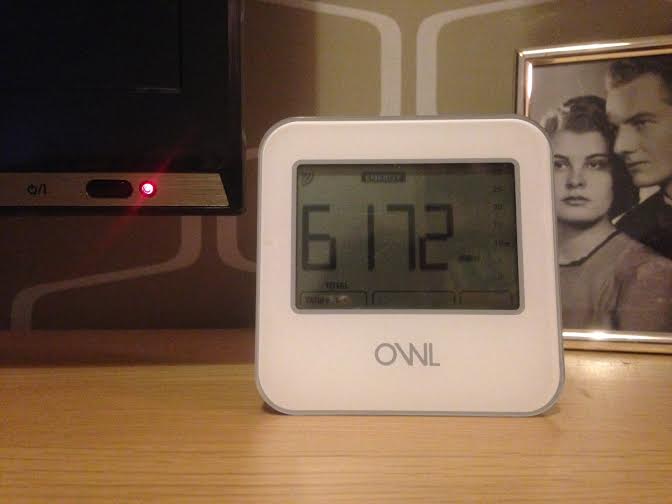
The OWL.
Here is my Owl. Why is it called an Owl? I have no idea. It doesn’t hunt mice at night, I wish it did. It’s not beautiful or strokeable like an owl I once met at a country fair. It is however rather enigmatic, which I suppose is like an owl.
From the front it’s a visual display with a thick white border. There are buttons on the back, which let you move between various depressing facts such as your current energy usage, its cost and your total CO2 tonnage since it began keeping records, and various less depressing information such as the current date and time.
One of my problems is that I keep not knowing what I’m looking at. When we first got it, the Gentle Giant talked enthusiastically about doing graphs and excel outputs so we could track our energy better. But we have a Ten Ton Toddler to feed, entertain, and keep away from live electricity and deep water. DIY data visualisations aren’t going to happen for the next few years.
I spent some time two evenings ago wandering round the house trying to figure out what appliance we might have left on as the readings seemed unfeasibly high. I have no idea. I tried switching almost everything off, throwing the Gentle Giant into darkness while he was peaceably doing some late night coding on his computer. It all made no difference. I think the wretched mice are siphoning off our electricity and having heated spas, discos and home cinemas in the cellar.
This evening, I resent my Owl. I don’t understand why it’s not working.
I know that if I logged onto our Owl’s website and looked at our energy readings I could probably identify what is causing this hideous spike in our energy usage, or find out that I’m looking at the wrong settings. I am procrastinating about fixing the problem because gadgets are outside my comfort zone. Perhaps aesthetics would make a difference – a tactile wooden casing instead of a plastic one to remind me what all this is for, the love of life. It could be designed to offer some element of reward, e.g. a Finnish study at Aalto University tried displaying more brightly glowing numbers when people had been ‘good’ and saved energy. (“Light is History” – Acharya, Mikkonen and Bhowmik, 2013). If I was missing having it in my life and functional, I would be more likely to fix it. That was one of the core messages I took away from Dr Jonathan Chapman’s book ‘Emotionally Durable Design’, which brought the ideas of the circular economy to life for me.
Above all, something that helped me see the puzzle factor in a more positive light would be enough to prolong the time I interact with it – something to make it feel like a puzzle with a key – a maze or a Rubik’s cube rather than being reminded of struggling with Maths at school. I would like the OWL to court me even though I’m dumb – in other words I am a Twit To Woo.
If we can find good and low-cost design solutions that make people feel more inclined to play and explore, we can get more people saving energy, money and carbon.
So, the election… yeah. That didn’t go the way anyone was expecting.
The prospect of a progressive coalition melted like a rainbow at dusk, and both Labour and the Lib Dems are in psychological shock. The Greens and UKIP both have every reason to call for electoral reform. The SNP must be excitedly planning how to spend or save their new political capital in Scotland.
The soul-searching of the Liberal Democrats and the Labour is painful to see, but what I’m curious now in the immediate aftermath is not so much the campaign mechanics of how each party rebuilds itself, but what the election tells us about national culture and which policy issues connected across voters.
Is there any core of values across the left-wing and/or progressive parties?
Given the fiendishly complicated Maggie Simpson map that is the British constituency system and my lack of psephological chops, the best I could do until the political analysts have done their thing was look at Lord Ashcroft’s polling on people who voted, and this absolutely lovely Buzzfeed article about the political maps of #GE2015.
Getting grounded in the facts, here are the figures for the proportion of the vote at the national level:
Parties
% of vote
Seats
Con
36.8
331
Lab
30.5
232
Lib Dem
7.6
8
UKIP
12.6
1
SNP
4.7
56
Green
3.8
1
Others
4
21
These figures are percentages of the 66.1% of the electorate who voted. One third of the electorate either did not want to vote, or fell through the cracks.
The first concern from a progressive point of view is that even adding up percentage shares of Labour, Lib Dem, Green and SNP is still less than the combined figure for the Conservatives and UKIP (Nick Clegg’s hypothesized ‘Blukip’ coalition). The Conservative result on seats is not counteracted by a progressive groundswell split over the other parties. Another concern for Labour is that turn-out was lower in regions where Labour did well on the night. If Labour did lose voters to UKIP when Nigel Farage ‘parked his tanks on Labour’s lawn), could it win them back and at least swing the popular vote away from the Conservatives?
Lord Ashcroft’s poll of 11,898 people who voted produced the following percentage shares:
Parties
% of vote
Con
34
Lab
31
Lib Dem
9
UKIP
14
SNP
5
Green
5
Others
2
So the poll is somewhat under-representative of the actual Conservative share, and over-representative of Lib Dem, UKIP and Green vote share. And of course it says nothing about people who did not vote. But it’s a good place to start comparing some numbers.
Is there any common core of policy issues of across the Labour, the Lib Dems, the Greens, and the SNP?
What was important to the people who voted for the parties in that hypothetical rainbow coalition that never was?
The people he polled were asked to rate the top three issues facing their country, and then asked separately to rate the top three issues facing them and their family.
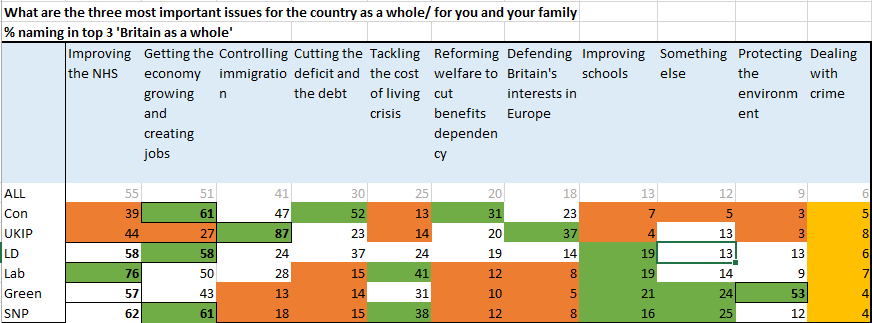
I ranked the data so that the issues were rated from most important to least important across all parties. (1)
Then I coloured the set of voters that found each issue most important in green, and the voters that found it least important in red. If another party’s voters were within 5% of the highest or lowest group of voters, then I coloured them in appropriately too. I put the most important issue for each group of voters in bold (or two issues if they were only apart by 1%). I highlighted ‘dealing with crime’ in amber, because all groups of voters were within 5% of each other, and it was a relatively unimportant issue for all voters. My charts are on this link: ashcroft country
The NHS
One of the things to stand out is that Labour voters distinctly thought theNHS more important than anyone else, but the NHS was nevertheless the issue most often selected in the top 3 issues facing the country not just by Labour but by the Lib Dems, the Greens and the SNP. However both the Lib Dems and the SNP had an issue which was just as important to them, (‘Getting the Economy Growing and Creating Jobs’ in both cases) and for the Greens, the Environment was not far behind the NHS. Labour voters were unusual in the distance between the NHS and the next most important issue (the economy and jobs). Only UKIP had a top issue which stood further from the others (immigration). Paradoxically, when asked which issues most affected them and their families, the NHS grew slightly or significantly in importance for all groups of voters except for Labour, for whom it decreased.
Economy and jobs
The voters most likely to agree that ‘Getting the economy going and creating jobs’ was one of their top 3 issues were the Conservatives, Lib Dems and SNP. Labour and the Greens were less likely to rate this issue in their top 3, but the surprise to me here was how low the UKIP score was – only 27% of UKIP voters put the economy and jobs in their top 3. This is especially surprising given that elsewhere in the poll, 51% of UKIP voters agree with the statement ‘I am not feeling the benefits of an economic recovery and I do not expect to.’ SNP voters had a markedly different reaction: they were the most likely to agree with the statement ‘I am not feeling the benefits of an economic recovery and I do not expect to,’ but rated the economy and jobs as their joint most important issue affecting the country.
Cost of living
‘Tackling the cost of living crisis’ moved up significantly in importance across all voter groups when asked to rate the 3 most important issues affecting them and their families, compared to its positioning when asked to rate the most important issues facing the country. The issue was up by 20% or more for Conservatives, UKIP and Lib Dem voters when asked its importance in relation to them and their families. It is hard to interpret this unanimous uprating in importance when the issue is considered from the personal rather than the national level. Possibly those voters were more swayed by the country issues than the personal ones, or equally possibly, perhaps they did not see the issue as owned by Labour.
Relatively unimportant issues – education, the environment and crime.
You can see that issues that did not feature much in campaigns really fell by the wayside in terms of the importance that voters gave them when asked about importance to the country. Education and crime were relatively unimportant to voters from all parties when asked to take a view on the country as a whole, and the Environment was only significant to Green Party voters (53% of Green voters unsurprisingly included it in their top 3 issues, against an average of 9% across the other parties, and only 3% of Conservatives). Education became somewhat more important when voters were asked to name the three most important issues affecting them and their family, although even then, only 18 – 22% of Lib Dem, Labour, Green and SNP voters put it in their top 3 issues. Only 13% of Conservative voters and 9% of UKIP voters put it in their top 3.
Do any parties place similar importance on the issues?
Looking at the top 3 issues for the country across all voting groups, Labour is not very close in its importance ratings to any other party. Looking at the top 3 issues for self and family, Labour is only close to one other party on issue: similar percentages of SNP and Labour voters rated ‘tackling the cost of living crisis’ in their top 3.
Labour, Green and SNP, and sometimes the Lib Dems become closer in their ratings on the issues that overall were not rated as most significant across all parties, such as education, Europe, and welfare reform. Arguably, the left-wing or progressive parties are more similar in what they don’t care about so much, than the issues they care about.
The Conservatives are very close to UKIP on many issues, but not on ‘Growing the economy and creating jobs’ where they are most like the Liberal Democrats and SNP, or ‘cutting the deficit and the debt’ where they are most like the Lib Dems.
How similar are Labour and UKIP?
Hardly at all. There are almost no issues where Labour and UKIP are close to each other in their ratings, which suggests it might be hard for Labour to reach that group of voters on other issues, even if a social consensus on immigration could be reached. There is no one piece of common ground. This could be very significant for Labour’s electoral prospects. UKIP’s vote share went up across the nation, even in Scotland. A growing portion of the population is choosing a party for whom the far and away biggest issue is immigration. UKIP’s stress on immigration is not only unmatched by any other party, the percentage of people choosing that issue in UKIP was higher than the percentage in any other party choosing their most important issue.
Overall, is there a common set of important issues among progressive and/or left-wing voters?
I do not get the sense of one progressive or left-wing voting bloc which circumstances split into different parties for this occasion – the different ratings in importance between the parties feel significant. It is interesting that the NHS did have such broad importance but that its cardinal importance to Labour (maybe reflecting its Labour origins) is unique.
It looks as though the Lib Dems and the SNP pulled away significantly from Labour in how much they rate the importance of the economy and jobs. Whereas UKIP and the Conservatives are quite similar in many things, but not on the economy, jobs and the deficit. And UKIP is not much like any other party in the primary importance of the immigration issue.
Perhaps the most worrying factor for Labour would be that of the voter groups who felt that the economy and jobs was one of the biggest issues, one is in a country that may become independent or at least more politically separate sooner rather than later, and those votes, lost this time, may never have the option to return again.
Voters rating issues in top three facing country
Voters rating top 3 issues facing them and their family
(1) Ranking the issues from left to right as most important to least important is based on averaging the percentages produced by each group of voters. It is not the same as saying that the ranking shows the ratings for the whole population as there would be more individuals producing some of the party percentages than others. But it gives a snapshot of something like combined party voice.
(2) The poll data also shows many other reasons why people voted – there is no intrinsic match between policy issues and voting decisions, as factors such as leadership, tactical or local voting play their part. But the policy issues matter if you’re trying to build bridges, which is what many progressives are thinking about now.
No-one should want to spend a long time on the topic of child abuse. So I am going to get through this as quickly as possible: talking about how businesses can help stop child abuse. I will cover some quick wins, some structural solutions in specific sectors, and then look at the big challenge – how to create a culture that prevents child abuse before it happens.
Anti-exploitation campaign in the tourism industry in Nicaragua: The dollies’ badge says ‘No excuses! We are children!’
There are corporate leaders in this area such as Visa Europe or the anti-exploitation campaign I saw at every tourist spot across Nicaragua (pictured) – so this is definitely a subject where business can make a difference. I’ve kicked off the Q and A here, but please join in and share your ideas for safeguarding children and vulnerable adults. NSPCC analysis indicates that one in five children in the UK have experienced abuse. As a society, do we want to live with that?
Q: This is awful stuff for sure, but it doesn’t seem like the job of business? Shouldn’t someone else be responsible for this, like the government, or someone like the UN?
A: There was a grim news report last week that the UN had sacked a whistleblower who leaked the allegations that French peacekeepers had abused children in CAR. It’s not the first time that such abuse will have taken place and won’t be the last but the UN should be throwing their resources at better safeguarding, not at sacking the whistleblower.
The UK government appears to be unable to resolve the ever-growing allegations that people with power in the British establishment abused children in systematically organised rings. It appears that politicians who abused children were aided by the police turning a blind eye. Important files were ‘lost’. The UK government failed for too long to find someone to head their inquiry into child abuse who was not related to or friends with some of the principal participants in the inquiry. The high-ranking political and legal elite of the establishment should be drawn from a nation of 60 million but you’d be forgiven for thinking they all come from one remote village, given the inter-relationships.
Some charities are doing a good job – although many of them could be more transparent about where things go wrong, and what their limitations are. But charities are not enough on their own to bring about a cultural shift. Businesses are everywhere, aren’t they? Why shouldn’t they have a go at fixing a problem that no-one can fix alone?
Q. I don’t know, this seems like cultural stuff, not business. Can’t we leave this to the Church?
A: Have you been living under a rock for the last ten years?
Q: Still, it’s pretty sensitive stuff right? You don’t want to just wade in feet first or you could make things a whole lot worse.
A: Acutally, I agree with that in some cases. But then there are other times that you just have to get on and do it. There are lots of charities who can offer good advice and there are lots of things that companies could do straight away that are low risk, cheap and simple.
Many firms have a code of conduct or statement of values. Inserting some language in there about safeguarding children and other vulnerable members of our community would start to send a signal. Firms could include clauses in contracts specifying that if a staff member was found guilty of child abuse their contract would instantly be terminated. They could state that employees who whistleblow will be supported. They would do it for fraud, or for dangerous work on a construction site. If they want to, they can do it for child abuse. It would be easier if it was part of a broad campaign to help everyone understand why it was happening now, but anyone could do this any time they want to. It could be an opportunity for staff engagement – everyone who has seen the news in the last few years will know this is a problem and might appreciate their firm taking a positive stance on it.
In company comms and media, firms can safeguard children by not providing identifying information. I read a Financial Times article which showed photos of children, gave their full names and the name and location of their nursery. Do the reverse of that. There are established guidelines on what not to do with information about children.
Some of the more complex things really make sense because brands’ products and services may be used by people who want to exploit children, and it makes sense for them to reduce that risk. I remember working with some smart people from Visa Europe on an education project and hearing about the work they were doing with CEOP to prevent Visa cards being used to purchase material which exploits children. Other financial services could look at how they could do similar things. Internet services such as Twitter have held up their hands to say they have no powers to stop trolls from bullying. If they were a bit more switched on about it, they could find structural things to do, helping build a culture where abuse is spotted, reported and resolved. Privacy issues should be thought about too but children’s right to be safe should take priority. Adults should be able to work stuff like this out so that children can be safe.
Tourism is an industry which has a particular role in helping to end child abuse: http://childsafetourism.org/actions/choose-child-safe-businesses/ Some companies are going to be trying harder than others. When you book a holiday this year, tweet or send an email to the company you booked through asking them to help end child abuse. I just tweeted AirBnB to ask them what their policy is. They seem like a thoughtful kind of company and I’m hopeful they’ll reply. I will update this blog if they do.
Thinking about holidays made me think about transport. A taxi company was linked to one of the huge child abuse scandals in the UK of the last few years. Some taxi companies prize safety, others do not. Taxi firms that screen their employees could make that part of their sales pitch. Of course those who do not have employees (hello Uber) are probably not in a position to do that. See whether your favourite taxi firm takes any steps to monitor the safety of its passengers and other people in their community.
Safeguarding children in other ways, eg from injury, may provide some quicker wins and kickstart a culture of child and vulnerable adult safeguarding. I expect construction companies have had to think about how to make their sites more child-safe. If everyone in the country spent 30 minutes a year thinking about whether there was one thing we could do at work to make children safer then we might be surprised at what we can achieve.
For whatever reason, we – in the UK and globally – have not yet built a culture that safeguards children. Those who wish to harm children are hopefully a tiny minority, but as the UK and UN examples show, their actions are enabled by those people who are either incurious and unconcerned, or perhaps worried that those with power will harm them should they try to protect the vulnerable. In the case of the UN, not only did it fail to protect the vulnerable, it failed to protect a whistleblower. The case shows that although it should be unthinkable for someone to lose their job for speaking out for children, it is entirely possible. And that’s the UN, not a rogue minicab operator.
Q: Some of these things sound like they could help. Still, it’s government and charities, not businesses, who are responsible for how people behave. Businesses can’t be held accountable for the fact that some people are just plain bad.
A: Except that some businesses make profits from the criminal justice system, and I would argue that they have a social responsibility to reduce offending – and it would also improve their reputation if society believes that such companies are not out to make a profit from human misery.
I’m talking about the operators of private prisons. This is an unlikely partnership for me to suggest as I believe in restorative justice, and reports such as those from the Howard League do not paint a rosy picture of private prison providers. However, it might be possible for such a private prison provider to innovate in its appproaches and find ways to prevent offenders from reoffending – or from starting to offend. It seems unlikely and I suspect they would try to pass off the delivery and reputational risks to the not-for-profit sector. The Quakers used to run a programme called ‘Circles of Monitoring and Support’ where they did what they said they would – monitored sex offenders but also supported them to overcome their urges to offend. If this sounds like being soft on offenders, that’s not the point. You may not personally believe that people can reform, but if you think it might help a child being lost, then think about whether you would support a prison provider to run such a programme. We are always hearing about how the private sector takes risks and innovates – so go ahead, innovate and save children. I leave the last words to Coral and Paul Jones, who lost their daughter April when she was five years old, as reported in the Guardian on 9th April:
“Paul Jones said: “If you are thinking that way and you haven’t committed any crime, if you call out for help, that can only be a good thing.
“If you don’t call out for help you might eventually turn into a Mark Bridger yourself. Someone calling out for help deserves a chance. If you do carry on and you become a paedophile, the law should be thrown hard at you.”
Coral Jones said she hoped the book could at least “save one child, one family”. She added: “If someone says to the doctor: ‘I have these feelings, can I have help?’, it would be better to try to help them before they ruin someone else’s family.”
One of the areas we discussed in our first week in Cambridge was the challenge of shifting business incentives from the short-term to long-term, which would line up better with sustainability. We recognised that shifting incentives to the long-term is a major undertaking and the conclusion I felt we were nudged to is that it can only happen if top leaders make those decisions. One of the lecturers made a comment that stuck with me: ‘no CEO wants to be the last’ – i.e. the one that brought the company down. I agree that key individuals can make big changes. But that leaves the question of how leaders represent and cooperate with their communities, and how we all look after the things we hold in common – nature and knowledge being two examples of that. My reason for doing the course was (partly) to look for ways to bring different cultures together in an alliance against ‘global public bads’ such as climate change. Community management is one way to preserve ‘the commons’ (see evidence for assertion below) but businesses as we know them are called the private sector for a reason. How could two such different things cooperate?
My one-line definition of the ‘Commons’ is that it is about how we steward the things we share, i.e. the things which are not privately held – whether that is a place of wild nature, or information on the internet. It is closely connected to the idea of ‘global public goods’, and some policy types have begun talking about ‘global public bads’.
At the social level the challenge of coalescing motivation to tackle climate change is big – I’ve even heard people who have children and grandchildren say that they don’t care about climate change because it won’t take effect until after they are dead. If people don’t care viscerally enough about those specific cute little members of future generations that they play peekaboo with, what hope is there that anyone would care for people from a different class, a different country, or a different time in the future?
And ultimately if people don’t care enough in their personal lives, why would they be motivated to make a difference at work – to lobby their CEO and lead in their own sphere of influence – or to be effective as a citizen, helping their community, being clear what deals they want governments to make for the common good, and protect us from our own worst selves. And so I sink into despair, think – whatever, might as well enjoy myself while I can, and leave the course and spend my free time drinking Martinis, sewing cocktail hats, throwing soirees and watching Modern Family. Actually, there has been quite the Martini soiree deficit in recent months.
But. If I was to let myself think that humanity in general is doomed to be as driven by short-term incentives as the consumer feeding frenzy of Black Friday suggests, I’d be misinformed. The actions of people all over the world prove that people are courageous and civil and smart and rational. And yes, tutors, there is academic literature to back that up.
The ‘Tragedy of the Commons’, the 1968 theory by Garret Hardin is supposed to prove that rational economic agents will inevitably over-exploit a common resource. The logic would be irrefutable if humans were only rational economic agents and not also members of a community, and if you suppose that rationality excludes knowing that if you eat every fish in the sea today, there will be no fish tomorrow. There is a video explaining the theory and its flaws here by Geof Glas: https://www.youtube.com/watch?v=lwaNZgY9PCQ which also refers to fish resources as a prime example of the commons. I’ll mention fish again later.
The Financial Times wrote an inspiring piece about Lin Ostrom, who worked on a much more positive approach to the Commons, and was the first woman to win a Nobel prize for economics. If I could time-travel, I would love to spend a day in her Workshop . Lin Ostrom, working with her husband Vincent, believed that common pool problems needed to be solved by a polycentric approach, i.e. that problems like climate change can be solved bottom up by communities, cities, regions: FT article: http://www.ft.com/cms/s/2/afc5377e-1026-11e3-a258-00144feabdc0.html#axzz3KUtaQ26d (paywall, but free subscription for three articles a month available).
The intergenerational commons
One of the questions that interests me is the idea of intergenerational commons. Although at the core of the Brundtland declaration: ‘development that meets the needs of the present without compromising the ability of future generations to meet their own needs, ‘ there is also a legalistic argument which says that you cannot make commitments to future generations because they are not yet people in the legal sense. And my anecdote of people not caring about events that will happen after they die shows that this is not just a legal but a cultural issue, and perhaps an intractable one.
A brilliant piece of research ‘Cooperating with the future’ (Hauser, Rand, Peyskhovich, Nowak) created a ‘public good game’ with the intention of finding out if there are means to prevent over-extraction of resources. Their research discovered that creating a democratic system to govern extraction is effective in conserving resources in the game, but only if it is binding. Voluntarism is insufficient. I loved this as a fusion of citizenship and sustainability research.
What does the private sector have to do with sharing?
For my first assignment, I looked at the insurance sector and the role it can play, especially in poor countries, in helping people manage risks. The rationale for studying this is that climate change is going to hit Asia disproportionately; where there are lots of poor people. The insurance sector, theoretically at least, appears to be among those whose incentives are more likely to be long-term, and more likely to be aligned with sustainability goals. There is a potential market (in line with ‘Base of the Pyramid’ thinking) and so it seems useful to find out why insurance schemes for low income people are currently not working, or at best are niche products, and to look at what can be done to overcome some of those problems. I’ll write another blog about my findings, about the importance of non-traditional business models (at least non-traditional to us in Europe) and how co-design could overcome some of the challenges.
I think my deeper interest in this topic is what it says about ‘the Commons’ and how that concept intersects with business. Climate change and the risks it will bring (is already bringing) to millions of people will, if we don’t stop it, be the ultimate ‘global public bad’. So looking at cooperation as a concept in the middle ground of ‘the Commons’ and the private sector, I thought that insurance is an example of cooperation within capitalism. You don’t usually go to the website of a major re-insurer for an inspirational quote, but I can’t describe the concept better than the Willis Research Network did:
“How can society, at local and global level, share the costs of extreme events…? Populations and institutions share and transfer risk by pooling resources … The principles of insurance underpin this vital function: insurance has been described as the ultimate community product; and reinsurance as the ultimate global community product. All insurance consumers participate in this global system of risk sharing and cooperation but many remain unaware of the role they are playing to support others, just as they will be supported when required. As risks increase, this global system of risk sharing will be fundamental to sustaining resilience for exposed populations and assets.”
It’s actually quite beautiful and surprising to think that through the mysterious workings of the market, we are unwittingly providing help to those who need it. Unfortunately, this market does not yet reach the most vulnerable.
Fish, community management and the commons
In the group project I am in, we are looking at the role of eco-labels in driving sustainability in the fish and seafood sector. I have come across several examples of community management as ‘by-catch’ of our research that provide examples of how and why community management works: i.e. for the simple reason that if the community exhausts its resource, its livelihood disappears so people are powerfully incentivised to conserve it. Community can operate at many different spatial levels, and this article from Swiss Re (another re-insurer) asks whether increasing national responsibility for oceans could help drive sustainability as a larger unit of community. (Sadly, the link to their earlier discussion on the ‘tragedy of the commons’ in relation to fish no longer exists).
Solving the temporal aspects of sharing the commons may require political action, but there is a lot of work we can do now in civil society and in business by advocating the effectiveness of community management approaches and looking more at the benefits and drawbacks of models such as cooperatives. And there are indeed drawbacks, as the Cooperative Bank’s widely publicised disgrace in 2013 showed, creating a sense of deep betrayal among many of their loyal customers, evidenced by the number of people switching accounts. Hybrid models that draw on business traditions and community traditions may be possible. My open question to all sides of the private/public/community triangle is whether we can learn and be open to change, even if that change comes from points of the triangle where we might not be willing to look for partnership. Do we care enough about the Commons to work with people with whom we might feel we have very little in common? Can the cooperative movement and corporate citizens share their ideas?
I went to a workshop on ‘leadership in collectives’ last week organised by a local community group, The Field at New Cross Gate. Jacob Stringer, a local writer, led us very effectively and inclusively through an exploration of leadership using story telling.
It was a very atmospheric space to work in. The Field have been working for some months to renovate their space, bringing the small building they are using back from a state of unloved and unused ruin. It’s very simple but beautiful – bare brick walls and stripped wooden window frames. The large table was turned into a smaller one by the simple means of taking a big board of the trestles, nudging them together, and putting a smaller board on top. It was also in the evening, and the room was lit only by a desk lamp, so I was lulled into taking off the usual professional masks I wear during the day and I probably opened up to the discussion much more than I would have done in a more conventional training room. Leadership is such a slippery, protean topic and so personal, so storytelling was a better way to think about it for me than trying to read what some survey of 10 or 1000 leaders have in common. Should a leader tell a story, listen to a story, co-author a story? Telling stories in the dark can’t nail the jellyfish of leadership to the wall, but it might have helped me dance with the jellyfish and have some fun with the idea.
I took away several ideas that I am still chewing on. The workshop made me realise how much my image of leadership is shaped by my work in international NGOs. If done badly, NGO work can lead to serious risks and dangers, either to ourselves, or to the people we are trying to help. In an emergency, you need a chain of command which generates a specific kind of leadership, which is difficult to shake off back in the London office. Even outside an emergency there are standards that are non-negotiable in so many areas – child safeguarding, project delivery to donor rules, financial accountability, keeping the teams safe. Getting the details of design right so that you don’t forget to send people the food they need to survive for a month. So while you might make as much space as you can for entrepreneurship and creativity, part of the leader’s job is also to hold the boundaries and keep discipline.
The first part of the discussion centred around different types of leadership, including functional or task leadership. It struck me that this is the kind of leadership being exercised in the group project on sustainable fisheries that I am involved with. No-one person is the expert or has any externally awarded authority, so different people take on responsibility for different areas. I deliberately held back from the project management role as I’ve done that so often and I wanted to see what new roles I could embrace. I can’t let go of my project management training too much as that’s what earns me my income, and I’m certainly experiencing some cognitive dissonance about the group project, but I’m trying to be more meditative about it and notice my responses to different situations and the different leadership responses that the group try out. And, I frequently remind myself, this is not NGO work. If we get this wrong, even if we get it 100% disastrously wrong, nobody will die. I am trying to relax more. I am bad at relaxing.
Earning the right to lead:
In the workshop, people talked about what had inspired them about the best leaders they had ever seen. I realised that one of the things that has inspired me most until now is bravery – either the physical bravery of our humanitarian team leaders whom we can deploy into an earthquake or a conflict zone and trust them to know what to do to save lives, or the bravery of people like LGBT campaigners in many parts of the world who risk stigma, imprisonment and violence to speak the truth about sexuality. I realised that this is part of my problem with my vision of leadership, because not all leadership involves confronting such visceral risks, and also because leaders should be allowed to have a personal life (which trauma or overwork can destroy), so it was incumbent on me to reimagine my vision of leadership. And playing with synonyms can be helpful in translating the concept to more ordinary life in the UK. The first thing I ever thought about the man who became my husband was ‘uh huh, bold…’ Bold is a good thing about leaders.
One of the other people at the workshop talked about being comfortable with a boss once, because he knew that they were working harder than everyone else in the team. I find that interesting because the boss who is working very long hours (visibly so, at their desk) is not necessarily a boss who I think is on top of their job and I would find a martyr-boss off-putting. But maybe hard work is a form of bravery, or at least of the combination of resilience and self-sacrifice that you could unpack bravery as being made up of. That train of thought led me to resilience and self-sacrifice as being more applicable than my first image of the brave leader as a hero in literally dangerous times. I toyed with the term ‘servant leadership’ but then decided it did not work for me, and neither did self-sacrifice. I have a family and I have ambitions other than work. And I want to be able to spend an afternoon in the garden without feeling guilty, watch cat videos and House of Cards and see my friends. I don’t want to take on a form of leadership that involves throwing away all the good things that make my own life worth living.
So that left me whittled down to resilience.
Then someone else talked about a person who had inspired them in the environmental movement. She described someone who had taken a negative message (the environment is being ruined and it’s all awful) to something positive (we can do transition towns). The energy and interest in her voice as she described that leaders’ ideas, and the sense that this leader was shaping a positive story about how we can reimagine our way out of the climate crisis, was a joy to hear. Futerra talk about this trait in a brilliant, charming, funny paper called ‘Sell the Sizzle.’ It resonated with the things we talked about in advocacy at international NGOs – we need to keep reminding people about the success stories like vaccines, we need to keep making the case that aid works. Positivity, encouragement, hope, saying ‘good job’ and ‘thank you’, listening, helping other people shape their story, making people feel recognised and valued. It’s the bit that it’s too easy to let go of under racking pressure, but this woman’s story reminded me that positivity is at least as important as resilience.
Another person at the workshop talked about the ‘gift of listening’ – that sometimes it’s lovely to give someone the gift of just listening to them really intensely. Which brought me back to my idea of the leader as someone who hears (or sees) – really hears, or really sees, each member of the group. (I put ‘sees’ as well as hears because I’m quite an aural learner but some people I know I visual. Tactile leaders must find it difficult not to touch and pat but they probably need to hold back. I think we can all agree that leaders should probably not lick or sniff their team-mates). Something I picked up at my Lean In circle a few weeks ago: in leadership, you ask simple, powerful questions. A leader asks questions and listens.
So there I go, my three takeaways from the workshop. My vision of what leadership looks like is a leader who is resilient and positive and who really hears/sees the members of the team. There’s quite a lot more to unpack there but it’s a start. As always, it brings me back to the words about work that I turn to often when I’m unsure:
“Work is love made visible.” Khalil Gibran.
I can’t love every day at work, but there is always something I find I can love in the big picture of my work. And what better source for resilience and positivity and the desire to really listen and see, than love?
I’m still puzzling over the problem of localism. I can see all its virtues in terms of making democracy feel more meaningful and enabling decisions to be made closer to the point of impact. I’m not cynical, and I believe that people want to engage. Yet there’s something about the debate on handing cities ‘control over their own destinies’, or at least their own tax-raising powers, that makes me uneasy. The lack of local accountability mechanisms is a main blocker.
I do think localism would be good for governance. But it has to be accompanied by a conversation about how we hold together as a society. For example, there have to be means to carry out fiscal transfers from richer to poorer areas to avoid entrenching regional inequalities. Also, I’m not sure how genuinely popular a move to localism would be. The current turnout for locally elected officials such as police commissioners is poor. Although there was a widespread passion for Scottish independence, there is not (anywhere that I have seen) the evidence that localism at the level of smaller units will be a smash hit. Presumably part of the issue is citizenship education, building confidence, skills and interest in building local societies.
I’ve seen my local area convulsed in a debate about a PFI streetlighting contract between our council and a construction contractor. Some of the issues might seem small to outsiders, in which term I include the council and the contractor – but they are vividly felt by residents. It seems fair to say that even if the contract is a success in terms of the metrics the council and contractor set themselves, it is a failure in terms of public engagement. Even someone as stroppy and well-informed as me was told that information I requested about safety standards was ‘commercially confidential’. I found the feeling of being told to shut up by my Council interesting, as previously I have always had a good experience of contacting people like my MP or MEPs. I am noting it down here to remind myself of what it feels like.
So (recognising of course that anecdote is not evidence) my experience suggests that people do feel passionate about their micro-locality, and the Scots referendum suggests that people feel passionate about their national identity. But if we are to make localism a success we would need to find that spot between the micro-local and the national where people have a sense of belonging and responsibility; decisions can be made; citizens can engage, and hopefully the work of local authorities can be made more efficient with higher quality results. Digital solutions such as City Dashboards, if stepped down a level to the local authority, could be one of the tools to help create a sense both of belonging, transparency, relevance, and even socialising and fun: http://citydashboard.org/london/. And the system of effects should be monitored to see that greater localism does not entrench postcode lotteries in issues like health services.
My main reason for doing this course was to expose myself to new perspectives, and avoid the risk of group-think that could come from a career focused only on one sector. Diversity is, I feel convinced, a key part of the sustainability response – different people have different perspectives and the blend, rather than one or the other, innovates and find ways to take good new ideas to scale. That’s why the core of my professional and academic interests are not in organisations per se but in partnerships and networks and in the definition of shared objectives between apparently disparate groups. I visualise the partnership approach as the equivalent of that machine in the opticians where they put a frame over your face and click different lenses into place, then say ‘better with this one? Or with this one? Better with? Or Without? With? Or without?’ When you and the optician have fine-tuned it you get that giddy sense that the world is brighter and sharper than before. That’s what good partnership and co-design means for me. Embracing diversity can bring challenges and that’s why we need to talk about it. If it was easy, people would be doing it anyway. A bit like moving to a more sustainable economy.
I have worked in mostly quite female-dominated environments, so coming to a course where of the 40 participants, 30 are men, was quite a novelty. I did not feel intimidated, or that my contribution was valued less because I was a woman. I felt more concerned that my NGO professional background would be a barrier. Language and cultural barriers may be more of an issue in our course than gender, and being an English speaker from a very young age I have easy access to all the course material. However I did look out a bit to see who was talking more in the room, I always do. It’s not a formal ‘air-time’ audit, but there were definitely some brilliant women in those rooms keeping quiet in the Sidgwick campus in September who I hope will speak up more in March. And some very thoughtful and reflective men and women who spoke little, but made an impact when they did, became role models for the week for me (I have a tendency to over-talk and lose impact as a result).
The experience did make me wonder about the career prospects for women in sustainability. It may be that women will equalise professionally in sustainability, but there is some way to go, see this article from 2014 where a specialist recruiter reviewed 600 sustainabilty leadership roles and identified that at the Director level, only 19% were held by women, just slightly lower than the FTSE 100 average. Essentially, the figures suggest that the same social and economic patterns which mean that few women hold top corporate jobs are reproduced in the sustainability sector, despite its sunny uplands of sharing and circular economies. There is a longer discussion of the visibility of women in sustainability leadership here: http://www.greenbiz.com/blog/2013/12/18/why-weinreb-report-sustainability-pioneers-left-women-out.
That leaves me personally with the sense that I have to have my lines ready – when speaking to clients or potential employers, how do I take their perception that I appear to be a maternity-leave risk off the table and get them to focus on the fact that I am a damn good, very hard-working and creative professional? I’ve stripped my Twitter profile of anything about motherhood. But using emotion wisely and well is also part of the resilience we were exhorted to cultivate on this course. In my last months at my last employer (I set up my own company in December) I used my own experience for the energy to work with an older, male, Somali colleague on geting the broader issue of diversity in our leadership into some forums where it might make a difference.
Part of the problem is probably my own conditioning. I noticed that on Twitter, I seem to mostly retweet things from men. Again, I haven’t audited who I follow but I suspect there is a majority of men. So this afternoon I looked at the Guardian’s list of top 20 women tweeting on sustainability and started following all those who looked relevant to my interests. I was delighted to see that Cristiana Figueres Twitter profile proudly declares three things : ‘Executive Secretary of the UN Framework Convention on Climate Change (UNFCCC). Passionate about fighting climate change. Mother of two wonderful young ladies.’ One day I will be professionally secure enough to own up in public to being a mother.
I also noticed (and bearing in mind that this probably wasn’t the most thorough research the Guardian had ever done) that most of their list of women tweeting on sustainability are independent consultants. There’s nothing wrong with that, it’s the path I’ve chosen as the one that makes sense of my choices now, and in my first month I’ve picked up three clients, and I have not even done a stroke of marketing yet. I’ve also been approached by good professionals who hope I can bring them work as well – all women as it happens – and if we, and any men who wish to join in, can find a way to support each other to lead good and interesting professional lives then hurrah. It’s partly now an unplanned experiment in work-pooling. Consultants who have been doing that work for a while need (I imagine) a large degree of resilience, self-confidence, impeccable organsiational and presentational skills, and great networks. Joining an established consultancy and building relationships with client after client, is not exactly easy, and starting your own enterprise, even as a one-woman band, is hardly easier. But that snapshot of women in consultant roles does suggest a certain type of leadership approach, that of the expert or perhaps the communicator, the person fertilising ideas rather than the person making the hard decisions, taking the flak and perhaps changing the paradigms from the top of a large business.
And out of that thinking about different perspectives, and the ways we find to deploy our skills, the idea of partnerships, of defining shared objectives and identifying ways to overcome differences of incentives and constraints, keeps coming back as a core theme. I’m just not sure yet how to incorporate that academically into my work.
I wouldn’t normally just post an article without commenting on it, but I’m nearly out of time for everything on my course, so I will have to. http://www.theguardian.com/cities/2014/dec/17/truth-smart-city-destroy-democracy-urban-thinkers-buzzphrase This article on smart cities and democracy is brilliantly written, it is a stream of crystallised gems. By Stephen Poole for the Guardian. It encapsulates everything that fascinates and worries me about smart cities and democracy. What if the thing that really got disrupted by technology turned out not to be cab rides and hotel rooms but democracy and our very nature as individuals with free will? My favourite paragraphs are these ones: ‘And what role will the citizen play? That of unpaid data-clerk, voluntarily contributing information to an urban database that is monetised by private companies? Is the city-dweller best visualised as a smoothly moving pixel, travelling to work, shops and home again, on a colourful 3D graphic display? Or is the citizen rightfully an unpredictable source of obstreperous demands and assertions of rights?’ Some really thought provoking stuff on how we can be predicted as crowds (something I suppose market researchers have known for a long time); and on the double-edged sword that is big data in both empowering citizens, but putting them under mass surveillance at the same time. I need to come back to this when I’ve finished my study obligations, there is so much to think about and unpack here.
Another great article to think more about here on the FT – 17/01/15:
It discusses the potential for Britain’s smaller towns to flourish more by becoming bigger. It quotes interesting numbers of inhabitants required to make various facilities viable: a nursery, a pub, a cinema.
Here’s another article that provokes some thought, although quite differently. Google are investing in an urban technology division (apparently to the dismay of their investors, who grow ‘restless’ about the tendency of Google to make long-term investments). What is almost most interesting about the article is how uncritical it is of some of the aims. It describes Uber and Lyft in Messianic sustainabilty terms as reducing demand for car ownership by making car service more cheap and accessible. Nevermind that they are not actually reducing demand for car usage (possibly just displacing that demand to hire cars) and certainly never mind the precarious employment situation and low pay of the people driving Uber’s cars. Similarly, the software predicting where crime will happen – tell me, journalist, exactly what sort of profiling does that software use? Would that profiling be legal in America if a human being rather than a machine was carrying it out? I’m a huge fan of technology and its capacity to make the world a better place. But uncritically failing to place technology in a social context runs risks of those technology gains being made at the expense of other important needs, like the needs for living wages and equal treatment under the law.


 British constituency system and my lack of psephological chops, the best I could do until the political analysts have done their thing was look at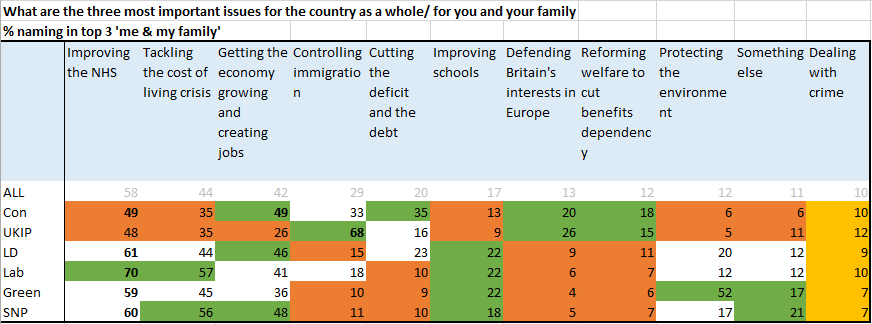


 Common Threads