I have been thinking about data visualisations a lot, which reminded me of one of the ideas I want to develop one day, but I will probably have to learn to code, so it’s some way off.
The idea is a visual participatory budgeting tool. It would mash up (for example) spreadsheet software with Google Earth and an image bank of animations of things like people walking, a bus driving, a midwife, a school. It would help people working with others to plan a budget in a way that can be understood by everybody, not just the person with the unenviable task of wrangling the Excel workbook.
The idea behind it is that all programme budgets that we do in NGOs involve trade-offs, because if you put money into one thing, you are usually be definition not putting money in something else. There’s not really a ‘line of sight’ (see what I did there) between the changes you make in a budget as you make the trade-offs during the process, and what that feels like in practise. For example, imagine you are planning a health programme in a particular area. You can afford six well equipped health centres with a staff of 6 people each, catering to a host of health needs. Then someone comes up with an innovative idea for something using solar power. Everyone loves solar power, it’s as irresistible to funders as a basket of kittens. You really feel you’ve just got to include the solar powered camel transported pharmacy or whatever the innovation is. Someone says that you should do research about the innovation to see if it’s effective so that you can scale it up properly later, so you put some research in the budget as well. Ooowee, academics cost a lot! So you’re over-budget. If you cut some centres that means some communities will still not be anywhere near a health centre. So someone suggests that you have two proper centres, but four basic health posts with two staff. So you draw them roughly and put them where they might go on google earth. That makes it easier to see what sort of roads and terrain you’re looking at. Are they physically impassable? If you know how many miles each health post is from the centre, you can quickly calculate petrol.
Perhaps you could take it even further in making budgeting truly social. Someone draws a floorplan, and asks the community on social media for three ballpark costs for building something on that scale. You get the thinky thinky people in the hivemind to do a quick and dirty peer review of your innovation idea. You could overlay the maps with environmental data, so you know you’re not proposing to build a new school on a flood plain. Or data from the UN about conflict levels so that you’re not siting that school between rebel groups and the government.
Would this kind of budgeting/planning software be commercial? I can see how you would use it in a development project when it’s really important to get participation in the project right from the beginning. And it would probably live in Beta for a long long time and look really rough to begin with. Someone would still have to wrangle it into an elegant but chunky set of workbooks for the funder. Would it be useful for businesses, e.g. in doing market assessments when they are thinking about expanding services into new areas? Would it help them consult a more diverse range of people and therefore get a more rounded view of what their new strategy might cost them?
But I think it could go somewhere, even if not as an accurate budgeting tool, then as a way to think differently about development. As we integrate nanotechnology into our bodies and we become part of the internet of things, it should get easier to virtually feel our way into a budget (unless we decide that actually we’re going to go all out on a rearguard action for privacy and biological determinism). We might be able to do a simulation of the programme we are trying to create. Obviously that would work better for physical, infrastructure heavy kinds of programmes than intangible governance ones. But in terms of getting more diversity of thought into the whole project planning experience, it could be a good way to go, and if it can build more ownership and support more bottom-up approaches to sustainable development, I would love to see it happen.
I’m sure that other people are thinking the same way, or even that someone is already working on it. If anyone is, I would love to hear from them. Maybe it’s already out there, please let me know if it is as I would love to use it. And if I’ve sub-consciously nicked this idea from one of the brilliant practically minded brainiacs I’ve worked with along the way, tell me and claim your idea – and then make it!
I have been looking at visualisations in relation to cities. Mainly because I stumbled across Luminocity 3d and I thought it was beautiful, but I didn’t understand it, so I had to spend some time looking at it until it started to make sense. A bit like those fractal pictures people used to have on their walls when we were students.
I have been interested in data visualisations in general for some time. The main reason is that I hope that visualisations could help make the cognitive leap we need to cope with complexity. I have always been enchanted by words and narrative. But as I grow older – words fail me. Mainly they fail me because there is too much stuff around that is really, really important, that I will never have time to read about it and that makes me stressed about whether I’m going to make the wrong choices. I suspect I’m not alone in this. My oldest friend Annika Mckee has recently introduced me to the concept of heuristics, which I understand as the study of the mental wiring that helps us take short-cuts through information, which we often need to, because the information is overwhelming and only a small proportion is relevant. Data visualisations cannot be the only tool we use, if only because relying exclusively on visualisation would exclude blind and partially sighted people (I doubt that Luminocity would be understood by a screen-reader). My question is whether data visualisations could be a way to help answer some of the questions in sustainability more quickly so that we can stay away from the environmental, social and economic cliff-edge that is out there somewhere in the dark. They are increasingly part of the way that people tell stories about issues on social media.
I love cities (because they are exciting, diverse and liberating) and I know that these complex systems are a huge nexus for both anxieties and manifestos of hope regarding sustainability. That cities are a ‘megatrend’ has become accepted wisdom, and as such, it should be unpacked. The challenges are well documented. Cities account for 37–49% of global Greenhouse Gas emissions while urban infrastructure accounts for over 70% of global energy use (figures from Climate Change: Implications for Cities, Cambridge Institute for Sustainability Leadership 2014). So my first question is whether visualisations can help us understand some of the sustainability opportunities around cities.
There is the challenge of defining a city, and of what to say about the people who carry on living in small towns and the countryside, almost as if the fact that ‘Cities are Megatrending’ (said everyone ever writing a strategy in the last five years) is less important than having a nice quality of life and knowing your neighbours. The Metropolitan Revolution: ‘How Cities and Metros Are Fixing Our Broken Politics and Fragile Economy’ (Katz and Bradley, 2013) talks (zealously) about metropolitan areas rather than cities, defined as ‘a collection of municipalities that together form a unified labor market and is often defined statistically by the commuting patterns of its residents between home and work.’ (p2). Eurostat provides a more detailed definition. In the UK debate about whether cities like London or Manchester should have more financial powers of their own, I don’t think it has really got into the public mind yet that this might have significant impacts on people outside the city, who might or might not consider themselves in any way dependent or financially responsible for the city.
So that was a bit of complexity to use to test whether data visualisation was a way to work through the question of ‘who is linked to the city’ without piling through all the statistics on the internet. I looked on LuminoCity 3D at the chart showing the flows of journeys to work. Apologies for the UK- centric and London-centric approach here, but I live and work in London , so I looked first at London and saw it defined by a new set of borders based on commutes. If you define it by the visual you see on LuminoCity 3D, then London stretches to Ipswich (Suffolk) to the East, to the Kent and East Sussex coastlines at Margate, Folkestone and Brighton, to Reading in Berkshire in the West, and Stevenage in Hertfordshire to the North. This map gives me a mental sketch that tells me that 9 counties around London have very significant numbers of people commuting to London every day. It would be interesting at some point to see whether the London Metropolitan area now extends further than the Eurostat definition, simply because the combination of house prices and okay (well, sort of okay) transport links create the market for massive commutes.
You can go into more detail on LuminoCity 3D. The chart on the left hands side tells you quickly that 832,000 people commute into London from other places every day, 20% of its population of employees. That’s more than the population of Sheffield and more than 10% of the number of residents in London. But it’s not all one way. 9% of London’s employed residents commute out. I can’t tell where to, because the lines on LuminoCity don’t show direction of travel.
Looking away from London, Brentwood is fascinating as nearly 80% of its residents commute out, but 80% of its employees commute in.
I’d love to know how this all breaks down further. Are women or men more likely to work near home, or is that possibly something that happens for the rich and the poor, while the middle gets (literally) squeezed on the commuter trains? LuminoCity only has UK data so we don’t visualise the elites who travel globally for work, what would they add to the picture? Why do so few people who live in Brentwood do jobs in Brentwood? Is it choice, or lack of choice? Who commutes to Brentwood and where are they coming from? What does the ‘good enough’ snapshot of commuter flows across Britain tell me about cities and opportunities for sustainable business (without having to think too much)?
Infrastructure and communications:
I’d make a bet that all these millions of people moving around the country every day to get to their job is not great for our carbon emissions. There may be a huge business and sustainability opportunity for companies developing home-working and e-meeting services. Personally I believe also in the social impacts of flexi-working. Less time on a train means more time with your family, or painting a picture, meeting your mates in the pub, chatting to your neighbours or digging in the allotment.
There is a new trainline proposed that will connect Oxford and Cambridge via Milton Keynes. Presumably at certain points in the timetable this will mean that Milton Keynes is briefly the most thinky-thinky town in Britain. Maybe Silicon Fen will start commuting in from little towns to the West of Cambridge. Maybe Apple should set up a new store in Milton Keynes to sell tech gadgets to the Fentrepreneurs who want to spend their leisure time browsing new smart phones. If I was Bristol or Colchester, I’d be lobbying for that trainline to be extended to me. Imagine what that East-West university highway could do to Britain. The exchange of thoughts, and wonderful R&D hubs and new businesses popping up all along it gathering and commercialising the best innovations from UK academia south of Leeds/Manchester and north of London, as well as giving Britain a new axis to distract us from the North-South divide.
Building new homes, commercial and civic spaces
Barratt Homes did a study for Centre for Cities on the need for more housing around London. Well, yes, people don’t want to spend 15 hours or more a week on a crowded, unreliable train, although I find it depressing that there are no voices talking about putting more good jobs in the places where people already live. There are alternatives for small and mid-sized towns with some investment: you could turn your market square into a wifi hotspot (as piloted in my Finnish harbour-side hometown of Oulu) and let the people work from picnic tables in the summer – maybe with renewably powered device charging stations. If we could make that work well, wouldn’t that be more beautiful as well as fun and productive? But if you must build houses where the jobs are right now, rather than spread the jobs around more equally, then the type of houses and the type of communities such projects would build are huge sustainability questions. You could build an architecturally gorgeous and fully BREEAM certified housing complex but forget that the local schools can’t cope with that many new kids and have a big local rift on your hands.
New businesses: is there a way to pick through this data and identify where you could find the skills and workforce to set up a new business or new branch office? Breathing new life into places, building on historic industries and creating exciting new opportunities for people. This is actually a live question for my family because himself and I want to move to the coast one day and need the economy and national business culture to catch up with our aspirations – or just get off our lazy behinds and figure out how to do it ourselves.
It’s clear that cities are major zones for the production of the effects that produce climate change, and it’s also clear after all this gazing at Luminocity 3D that the policy definition of a metro area has nothing much to do with the cultural image of a city. Data visualisation has helped me bridge that gap between my romantic image of London from Waterloo Bridge, and the opportunities that businesses and social enterprises may have in making metro areas into places where people can live well without compromising the lives of future generations (the core of the Brundtland statement on sustainability), or the lives of people living outside the city. Could thinking through what the mega-city looks like help us build better human-scale communities within the city, and even provide benefits to people who live at or outside the boundary of our own metro?
Before the referendum I pledged to write to my MP if there was a no vote pleading for the wishes of the Scots to be respected for greater devolution of powers, whichever way the vote has gone. But as things turned out, there was no need to lobby for further devolution (yet) as that was promised, ooh, whole days before the election, without about as much thought gone into it beforehand as I put into choosing my lunch.
I hoped very much it would be a ‘no’ as my family crosses England, Scotland and countries outside the UK altogether, and the run up to the referendum was a period of great frustration for many of us denied not just a vote, but a voice altogether. As time wore on, I sympathised with more of the ‘Yes’ campaign, especially every time the parties in the rest of the UK rattled their sabres about leaving the EU. My husband would apparently have been eligible for citizenship (although ironically, not eligible to vote) and I indulged in one of my daydreams of moving to Edinburgh and watching from afar should UKIP really start tearing the UK to shreds. Still, the ‘no’ vote came as a relief, but it was sad and there was no celebration. I knew how the ‘Yes’ voters must have felt because I know how devastated I would have been if they had won. I thought ‘that’s how I would have thought about them if they’d won,’ when I heard people in Scotland on the ‘Yes’ side who were furious in their grief, like David Greig who said: ‘The result was, in those final weeks, a feeling arose that if we voted Yes we’d be yoked to a grieving, lunatic, hostile nation to the south.’
And then, repulsively, as things have turned out, there has been a huge spillover from the Scottish referendum into ‘English Votes for English Laws’, claims of greater tax powers for London, (even for Croydon), party politicking with the legal soup we call the Constitution. There is no national leadership. We’ll go to Dundee for the first time since the referendum in a couple of weeks and see what the mood is there, but down South, the only mood I’ve seen is, ‘so enough of that brief interruption where we talked about Scotland for a fortnight, let’s go back to talking about me.’ And the only thing in all this I might get a vote on is London.
I complain that there is no-one talking about the common good, nobody talking about cooperation or trying to heal the injuries in relationships between people since the referendum, and no wider appeal to the fact that a few months ago, politicians here were vowing that we were ‘better together,’ in the general landgrabs on resources and party-political constitutional rigging that is going on at the moment.
I hoped that Scotland would not separate, and I don’t believe that London, or any region, should take further steps towards isolating its budget from the rest of the country – because it is too short a step from there to refusing help to parts of the country that need help. We are all interdependent, and likely to become more so. Why should London keep its tax revenues itself when its workers commute in from the counties all around? Why aren’t we giving away some of that money to create jobs nearer where people live, rather than proposing to make the centrifugal force of London even stronger? Why not take some of the pressure off London, and its overheated housing bubble and over-stressed infrastructure?
Even worse, people seem to be abandoning the idea of mutual help. Climate change could bring about floods or other disasters in the richest or poorest parts of Britain, and so we never know when we might need the help of a city or region in another part of the country. Many of us don’t know what the changing economy will bring for us and so community should become more important to us, not less. I can’t imagine saying to my family that I would vote for London to keep more of its own tax revenue, if I had even the smallest reason to believe that that over time would mean London staking a claim to its ‘own’ money and not contributing to the public purse to help parts of the country that will never be so well off.
Which is not to say that more devolution might not help. We have social problems and economic inequality in the UK, and perhaps devolution would lead to innovations in governance based on a deep understanding of the local context. Local charities, small businesses and social enterprises might find new roles based on closer access to power and a more pragmatic, tactical, human scale politics that is less combative and ideological. If we could have that, and still have the idea of helping and being helped, and of thinking actively about how the country as a whole can develop, not just the city or region we are in, I would vote for that. The post-referendum debate could have become about citizen engagement rather than gone straight to taxes, and maybe it still could.
But I’d have to be more sure about it than I am. Maybe local systems would develop new power elites, and cronyism could thrive. Maybe competitiveness between neighbours would result in a race to the bottom and an attempt to export one unit’s problems to the next. Southwark Council’s leader being wined and dined in Cannes by companies he then sells housing estates to, isn’t a great advert for localism.
Maybe one day I’ll vote for London to be a city-state, but I don’t think so. I have family ties to Dundee, East Devon, York and parts of Lincolnshire. I have studied in Leeds, Norwich and Cambridge. I have daydreamed about moving to Edinburgh or the North Essex coast. And I can’t begin to list the places that I have got to know and like because friends hail from there or have moved there. And that’s just the UK. Many of my friends are bi- or tri-national and multilingual, and I can’t imagine trying to unravel their lives, or force them to choose one identity and reject half their family through something like the Scottish vote.
In the days after the referendum, I decided after years of dithering, to apply for British citizenship. Partly I’m tired of having paid taxes for 18 years without representation, partly scared of the way that the mood against Europe threatens the basis on which I’m here. But also because the Scottish referendum made me realise how viscerally and passionately I care about Britishness. I agree with Billy Connolly when he talked about his distrust of nationalism, and his sense of community with people beyond national borders. I was raised to believe in solidarity more than in national borders. But you have to have an identity of belonging to convince people that you are arguing constructively from a position of love, and British politics and culture, including the left-wing and the ‘Yes’ campaign have gone down the path that says that a geographic identity is the primary form of belonging. So I will apply to be British, and I feel happy about it. We have so many identities and the power of Britishness, it has felt to me now that I have decided to apply for citizenship, is that you can be British and something else too: a Yorkshireman, a Scot, a Finn – and that’s just my closest family. But if that identity does not mean mutual help, it cannot build anything else, and has only a symbolic role. Losing all that mutual help in a spate of local devolution would be a long-term injury that would outweigh any short-term economic benefit. If I become part of that system then I will be able to vote for mutual help.
On the Friday, it was a non working day, so I stayed at the guesthouse. I swivelled the desk in my room around so that I could see the pretty garden through my open door. I relaxed my adherence to the dress code by slipping on a long sleeved but close fitting shirt when I sat in the garden to eat. I saw something on CNN about American citizens concerned at a threat to their right to bear arms. I saw a male guest sprawled blissfully on the lawn enjoying the bright sun, and longed for the right to bare arms. When I looked up, the the cloudlessness of the sky made it feel like being at the top of the earth’s atmosphere. Nothing between you and the nearest star. I lay on my bed after breakfast and wiggled my toes, and imagined I was back on that Italian holiday with my husband, and that it felt this hot and gently breezy, but I was wearing only a sarong and feeling the sun and the sand, and him kissing my lips as he came back out of the sea. Then memory became unbearable and I sprang up, got out my laptop and got to work. Lost in budget quarrels and resource puzzles for the next nine hours. Then at about 7pm, there was a very minor earthquake. My chair rose and fell as if it was on the sea. I stopped typing, unsure whether I was just exhausted and losing my balance. The water in my plastic bottle shook and waved about. I quietly put on my headscarf, ready to take some sort of action. I thought, this is ridiculous, I work for a humanitarian NGO and I personally have no idea what to do if there is an earthquake. I can do First Aid, but only if people are lying down calmly on the carpet for me to check for broken bones and bleeds. But nothing more happened. I opened the door and guests and visitors were sitting in the garden, chatting and drinking tea. The earth was not opening up, and I decided to treat myself to a tonic water and some time with my Kindle amid the roses.
That evening there was a family party at the hotel. Bored and lonely, and a bit unsettled by the earth tremor, I stalked it – sat at a table where I could see the family members going in, kissing the children, greeting each other on the steps. Some little boys ran around, and played near me and said ‘hi’ very softly, drawn by the cat that was petitioning earnestly for a share in my kebab. Then off they went, clattering about looking for mild mischief. Some of the older men pulled a carpet to a quiet corner of the garden and bowed down for prayers. All sorts of fashions went in. The most glamorous lady wore a black frocked tunic, heavily embellished with silver studs and blue and green embroidery, black skinny pants and a black chiffony embroidered headscarf. Most of the older men wore their shalwar kameez plus waistcoat combo. Some women wore Western shirts over trousers. The little boys wore either mini shalwar kameezes or mini dinner jackets, presumably in line with their parents. I could see they had balloons, and they had live music. Like the Finnish, there seemed to be a preference for mournful tunes despite the happy faces everywhere. My gramdmother always sad that sad songs were more beautiful. I saw briefly a woman unscarfed, thick black glossy hair briefly visible, terribly beautiful. In the curtained windows I could see silhouettes of dancers coming closer and moving further off, like a shadow puppet dance.
The next evening, fortunately for my sanity, I went out for dinner with a former colleague whom I had discovered was in Kabul through skype. It was lucky as a combination of long work days and social isolation was wearing down my mental grip on happiness. We went to the exquisite Design Centre Cafe in Kabul.
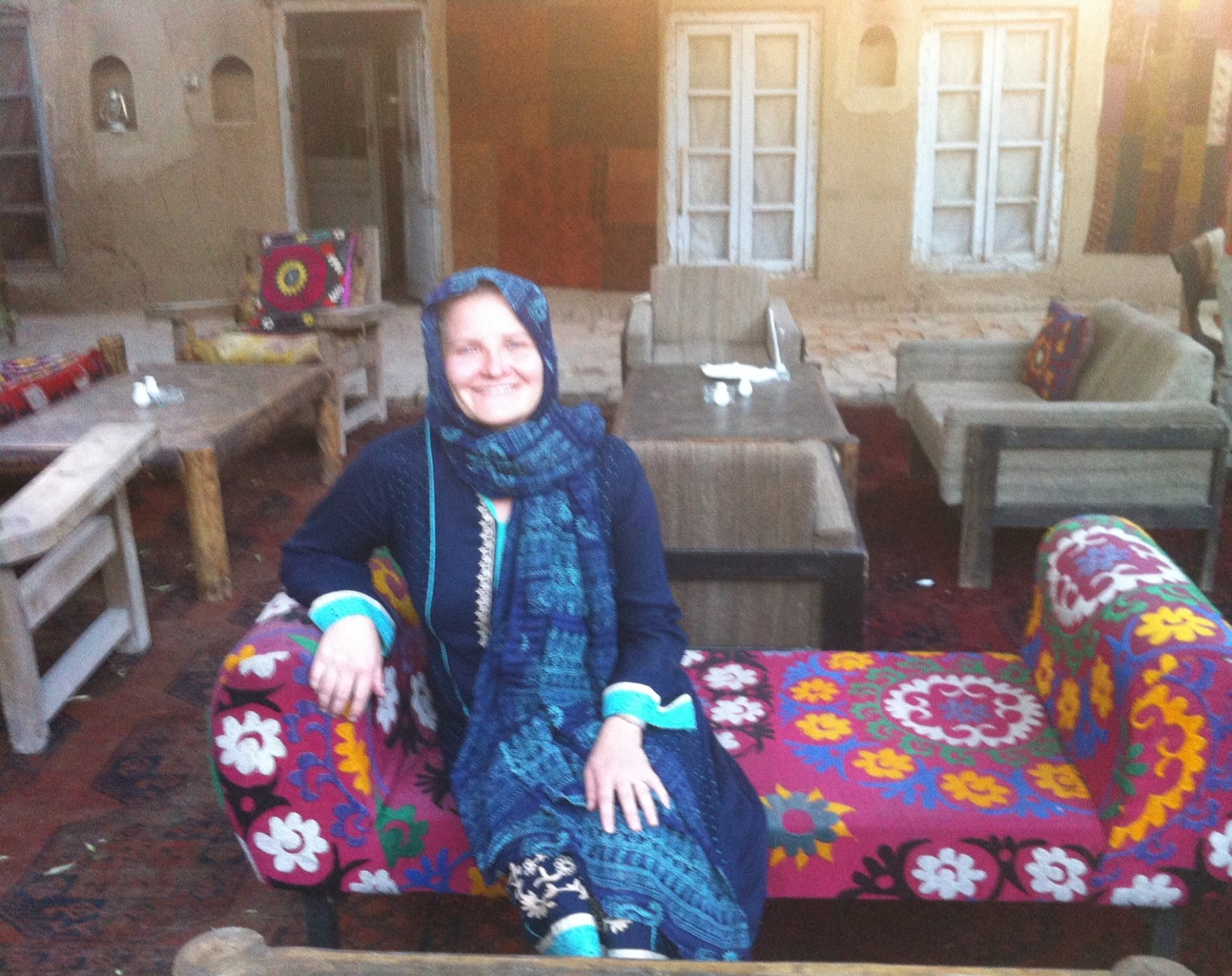
The place, behind a plain metal door in the exterior wall that gives away nothing, was just beautiful. Tapestried armchairs and low tables were set around an open but carpeted courtyard. The interiors were gorgeously stylish with old dark wood and candles and embroideries and carpets too, but I always love ‘outside in’ places, and one of the bits about hot climates is being able to live outdoors – so we did, that evening. In one of those weird moments of extraordinary privilege, we went into a room where carpets were being displayed, and met the designer Chuk Palu, who showed us carpets that he sells at Liberty and I could maybe afford one of if I stopped going out for six months. Some of the carpets were woven new but designed old so they already looked like antiques that you might find at the Victoria and Albert. I had been writing about carpet making that morning – it’s one of the few sources of income available to poor girls in Afghanistan, but unfortunately the need to earn money often takes precedence over education – and would it not with me? I wished that I could support this beautiful industry. The carpets made me wish I was richer, and I suddenly had a flash forward that in 10 years time, if we all just supported Afghanistan with development rather than pretending that we might ever be able to meaningfully interfere with its politics, Afghanistan might be the next Lebanon. If we had realised this fifteen years ago, I’m sure the world today would be a better place. It was strange visiting Afghanistan, this country that has come to influence much of what has happened in world politics over the last ten years, and feeling so confined and isolated that I’d had barely more experience of the country than I would have done from reading a good book about it. What else did I see? Kabul is one of those cities overflowing with small scale and big scale entrepreneurs, bumping up against high walls with barbed wire and armed guards. A female politician was shot dead during that weekend, allegedly for not wearing her head scarf – but who knows who she angered and why. But there is huge and widespread support for girls’ education, including from the places where as a Westerner, our media teaches us not to expect it. Day to day, people are friendly. The guards at my hotel were determined that I should be able to say in Dari ‘hello. How are you you? Thank you, I’m fine.’ Weddings and family parties are a huge deal, and joined together by a lived faith and by a value for spending time with loved ones. The food is good. There is world class design behind those bleached yellow Kabul walls. I pray that Kabul and the wider Afghanistan will prosper.
On the plane, I went to sleep as soon as I sat down, exhausted already by the night flight from London, and woke up with two high school or student aged girls. They were both smartly dressed in narrow black pants, black tunics embellished with silver, and light black scarves; one chiffon embellished with silver threads, the other soft black cotton or viscose with silver, leopard like spots. We got chatting – they had left Aghanistan five years ago, had settled in Peterborough, and were returning to see family. They were as keen as I was to see Afghanistan from the air as we approached. Leaving the azure waters lapping the desert of the Gulf behind, nearer Kabul we saw endless rows of dry bleached yellow mountains, with what looked like chains of fields threading their way through the valleys. I asked if their family would think they had become too British ‘Yes, maybe,’ they replied together, laughing. The two girls and I shared a fear of aeroplane turbulence, and giggled nervously together at landing. They were part of a much larger family group, it turned out – my last glimpse of them was at the baggage carousel, where the elder one looked like someone born to lead orchestras or nations, with relations and porters following the rapid gestures of her arms to fetch copious volumes of baggage, while the smallest members of the family danced around her like a maypole, running off to the exciting carousel, and back again to safety.
At the border control, I was relieved when the guard laughed at the photos clipped inside my passport for various official forms. One of my colleagues had said that in my passport photos I look like a psychopath. Other things were funnier, but not suitable to be written here, to do with various types of criminality. All agreed they would not let me into their country. The guard was quite chivalrous, and said ‘is that really you? Maybe it’s your sister.’. I thought of my pretty sisters and laughed. He stamped my passport and I had entered the country. Would he have been friendly if I had not been wearing a headscarf? Probably, but why take the risk? Foreigner registration was slightly less easy, with a man barking at me that I should have brought a work permit, not a visa. I explained why I was here, his colleague looked at my passport, and then they stamped my registration form. It probably wouldn’t have been harder if I had been bareheaded, but again, I felt more confident arguing with them knowing that I had not possibly offended anyone before even opening my mouth.
The five minute walk to meet my greeter at the car park was almost unbearably hot. I began to hate my woollen scarf. I met another lady who was visiting the programme who had come in on the same flight. She’d had trouble finding the car park and asked for help. Her head was covered, but the airport men who jovially assisted her had told her that ‘people in Afghanistan don’t really like women who don’t wear the burka.’ I attribute half of that to the way some men like to frighten women almost as a form of flirtation (‘it’s ok lady, you’re in safe hands now,’ kind of thing). A casual glance at the streets told us that wasn’t true. Some women wore the burka for sure, but others wore smart black tunics and pants, others wore green and pink shalwar kameezes, there were as many ways for women to express themselves through fashion as there were in London. Except I was not making a fashion statement, I looked like a bag lady wearing badly assorted clothes, and I was ridiculously hot. We passed through traffic so hectic I nearly didn’t see the soldiers passing with a gun mounted on a flatbed truck. First impressions of Kabul: bustling traffic filled, shop-lined streets, houses that matched the bleached yellow brick of the encircling mountains. Then there was a side street, a metal wall, a man with a gun in a metal cubicle surrounded by sandbags. I had arrived at my hotel.
Between the office and the hotel, I was driven past a road with shops selling evening gowns and Western wedding dresses. ‘Who wears those?’ I asked a colleague. ‘Afghan brides,’ he replied drily. I puzzled over how a woman in this dress culture could wear a strapless, corseted Pronovias dress when the rest of the time they must be covered. Then a colleague explained, she will only be seen by other women. Men and women celebrate the wedding in different rooms. There is a ceremony between the groom and his father in law, and then a messenger will go to tell the bride that she’s married. At one point she will sit with the groom to receive guests – but the enormous neon lit wedding halls, for the massive and loud Afghan weddings I could hear nearly every night from my hotel in downtown Kabul, are separated inside for the parties for men, and parties for women. Having been married three months ago, it felt like a different way to do it. At the office, I had nearly made a gaffe on my first day by going to eat lunch at the men’s table, but caught myself just in time. At the hotel, I ate on my own every night. There was a male colleague staying there, but in addition to traveler reticence, offering a colleague ‘space’, I felt I didn’t want to expose myself to observation by brazenly walking up to him to suggest we eat together. After a few days there, my goal was invisibility.
I spent 10 days in Afghanistan for work. I’m supporting a team there planning a large education programme. They bring knowledge, I bring post it notes and flipchart pens. Together, we can. But hope. Please nice donors, fund us!
Before I left, I faffed with my packing. Evening upon evening, my husband came home to find me rummaging through my clothes, muttering vengefully about moths. The way to get round the modest clothing issue with a Western wardrobe, I had discovered, was a long shirt or dress over trousers. But it doesn’t stop there, the ‘cultural awareness’ photocopy lets you know. The trousers must be wide legged, and the sleeves of the dress must come below your elbow. Nothing must be sheer. It’s so obvious that the neckline should be high that they don’t even mention it. Fortunately I’m a fan of wide-legged pants (Fenn Wright Manson or just Top Shop) but I have literally one long shirt that meets all those criteria, and (since a great shopping trip in Islamabad) one beautiful shalwar kameez. But that wasn’t going to get me through 10 days in Kabul. So the answer is – layering. Trousers, a dress worn back to front so that the low neckline is hidden, and a strange black coat that my best friend was getting rid of because it was too shapeless, and I, squirrel-like, hoarded. For this day, it turns out. This day of 35 degree heat.
I took my Kindle with me of course, and started reading Moby Dick. Even there, Afghanistan was ready to meet me. Herman Melville uses a reference to this desperately important land as an ironic comment on the long repeating cycles in the news, and casts his narrator Ishmael’s boat journey as part of a global epic by this reference which could have been as pointed in 2001 as 1851:
‘And doubtless, my going on this whaling voyage, formed part of the grand programme of Providence that was drawn up a long time ago. It came in as a sort of brief interlude and solo between more extensive performances. I take it that this part of the bill must have run something like this:
“Grand Contested Election for the Presidency of the United States
“Whaling Voyage by One Ishmael”
“Bloody Battle in Affghanistan”‘
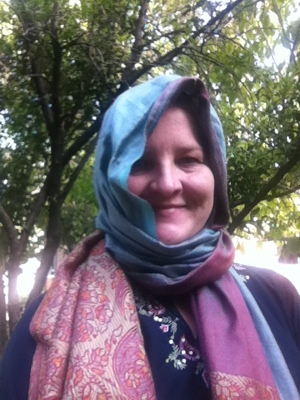
Then there’s the business with the headscarf. I love hats and fascinators, so I was fascinated by the idea of covering my head. My colleagues were quite clear: whenever you go outside, cover your head. When you arrive at the airport, have your head covered. If anything goes wrong and you need help, people will not respect you if you do not have your head covered. I was concerned about the details. ‘Do I have to pin it, or is it okay to wear swathed loosely about my head? I don’t know how to pin it. ‘ I asked one of my new male colleagues. There was a pause at the other end of the line. ‘just wear one, it’s better.’ But then what kind, and what to do with my hair? I have fine blonde flyaway hair, and if the whole point is that my bare head is offensive then the straggling strands around my face would be an insult both to my host country and the patient efforts of my hairdresser. I decided I would wear a headband to keep the flimsy strands discreetly hidden.
I planned some outfits, but could not figure out how to appear as anything other than an eccentric British lady who, for reasons of her own, prefers to wear all her clothes at once. I hummed and hawed over the choice of headscarf with which to make my respectable debut at Kabul airport. The pretty ones from Pakistan would have to wait until I’d sized up the prevailing attitude to decoration, and I packed a plain grey wool scarf. A floor length full skirt borrowed from my best friend, my long black longsleeved shirt, and a shapeless macintosh completed the look. Sitting at gate 5, terminal 2 in Dubai (very much the Stansted of Dubai, a hot 20 min bus ride from glittering terminal 1) I tried to gain a sense of dress culture. Standing in queue to board, I thought there were relatively few women at all, but of those there, only two or three seemed bareheaded. So I bowed to the majority, raised my scarf over my head, and lowered my eyes.
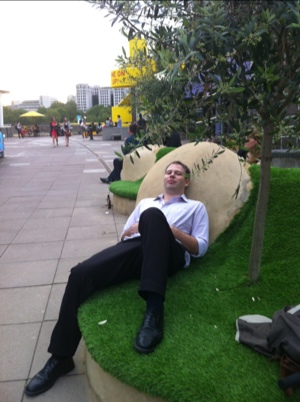
It was grey and mild, but not positively raining or actually cold, and in a summer like this one, we were pleased with what we could get. So we decided to have dinner outdoors, and strolled through the South Bank in search of a table, but yet again discovered that whenever we have had a good idea, a crowd has had it first. What can we do, we have mainstream tastes. But we found a corner with a Lebanese Tellytubby landscape of rolling astroturf mounds interspersed with olive trees ending in a Beirut streetfood stall. A 30-strong improv class outside the Royal Festival Hall laughed, groaned and chattered in unison. We got wine from the Queen Elizabeth Hall and leant back, wondering what the middle aged version of gilded youth was, and whether this was it. We argued indolently about what the other sound was. I thought it was more art: perhaps a sound installation but Toby thought that Skylon restaurant kitchen had their window open. The only large mechanical fly in our ointment was helicopters, their low-flying mechanised downdraft juddering through into the ground, and I blamed the Olympics.
As we were leaving, we saw a sign saying ‘garden’ and pointing up one of the South Bank’s concrete spiral stairs. Feeling a bit like Alice instructed to ‘drink me’ up we climbed, and found ourselves in nature. The garden has been cultivated by volunteers supported by the Eden Project, where gardening is therapy (isn’t it always?) and as the tomatoes and sweet-scented stocks grow, the demons, hopefully, dwindle. The space is divided into a (real) lawn overlooking the river, a meadow, vegetable planters, and an alley trellised with honeysuckle. The whole thing is a great slab of gorgeousness, a gift to the city. Dusk was falling and I was tired, so we made to tear ourselves away. We tried to emulate the spirit of the Meadow by clearing away some of the bottles a corporate party had left behind, and texted a donation. We’ll be coming back to our new favourite place before long.
A friend sent me these words from her colleague, who is seeking to liven up their office kitchen. Poor Finland:
‘It would be fantastic if I could put up some prints of the ‘local neighbourhoods’ of all our overseas colleagues, pictures of USA, France, Spain, Germany, Turkey, South Africa, Asia, even Finland would be most welcome.’
I don’t mind that people think of ‘even Finland.’ My Finland is both a place of love, where family live, and a place of healing, where the midnight sun gives me moments of colour therapy that stretch into hours, watching the forest go from green, to golden, to copper. It’s capital city gets written up in the Financial Times as a design destination. It has its Disney at Santaland in Rovaniemi, and Moominland near Turku. There is a week in summer when I always get a craving for peas. When my husband and I went to Turku last summer and saw the market stalls laden with peas, in their perfect moment, nearly as sweet as their pallet-mates the strawberries, he got what I was questing for with the weird pea craving. He said there must be a primal part of me that physically senses from afar when its peak pea season, even when we’re in our urban a-seasonal globalised life in London. That lunchtime in Turku we sat on the grass by the twinkling river and ate them with hot smoked salmon from the foodhall then fell asleep in the sun. I’m okay with ‘even Finland’. It’s a country for the pleasures of home, and the imagination.
My friend reminded me of the strapline on the Lonely Planet, the year she joined me for a summer holiday there – it was something like ‘why not give Finland a chance?’
I reminded her that I have a picture of her twirling around in a towel at dusk under Lappish pine trees after a sauna at my aunt’s log cabin, but I don’t think her office kitchen is ready for that.
However, here’s a snap I happened to have on my phone from last summer in Sotkamo. I don’t think it’s so dusty, myself.
Newsflash! 26th July 2012: My uncle’s family’s midsummer at the place snapped above appeared in the New York Times!







 Common Threads